January 17, 2022

"BAPTISM" What About "Re-Baptism?" by Mark Copeland


"BAPTISM"

What About "Re-Baptism?"

INTRODUCTION
  1. In our study of baptism we have seen that it is...
    1. Essential
      1. To salvation - Mk 16:16; Ac 2:38; 22:16
      2. To becoming disciples of Christ - Mt 28:19-20; Ga 3:27
    2. Immersion, not pouring or sprinkling
      1. The Greek words can only mean immersion
      2. Pouring and sprinkling do not fit the FIGURES used to describe baptism in the NT.
      3. Scholars are unanimous that immersion was the practice in the NT
    3. For penitent believers
      1. For sinners with faith in the Lord Jesus who have repented of their sins
      2. Not infants, who are incapable of faith and repentance
  2. Another question that is often raised: "Is there ever a need to be re-baptized?"
    1. What about those who were sprinkled?
    2. What about those baptized as infants?
    3. What about those baptized believing they were already saved?

[This study examines the question of re-baptism, first by noticing...]

  1. A CASE OF "RE-BAPTISM" IN THE NEW TESTAMENT
    1. RECORDED IN ACTS 19:1-5...
      1. Background information is found in Ac 18:24-28
        1. Apollos had been teaching the baptism of John
        2. But he himself was taught more accurately by Aquila and Priscilla
      2. Paul finds some "disciples" at Ephesus - Ac 19:1-3
      3. Upon further examination he has them "re-baptized" - Ac 19:4-5
    2. SOME OBSERVATIONS...
      1. They had been previously "baptized"
      2. But their baptism was lacking in some way
        1. Even though it was immersion
        2. Even though it was "for the remission of sins" - Mk 1:4
      3. But their baptism was not in the name of Jesus, i.e., by His authority - Ac 2:38; 10:48; 19:5
        1. Which would have been a baptism into the name of the Father, the Holy Spirit, and the Son - Mt 28:19
        2. Which would have been a baptism into the death of Christ, by which they would have been clothed with Christ - Ro 6:3-7; Ga 3:27
        -- Because their first "baptism" lacked an essential element, "re-baptism" was necessary!

      [May we not conclude that if an earlier "baptism" lacks some essential element, then "re-baptism" is necessary? To determine whether "re-baptism" is required of us, consider...]

  2. WHEN "RE-BAPTISM" IS APPROPRIATE
    1. FOUR "ELEMENTS" CONSTITUTE BIBLE BAPTISM...
      1. The proper mode: a burial (immersion) - Ro 6:3; Col 2:12
      2. The proper authority: in the name of Christ - Ac 19:5
      3. The proper purpose: for the remission of sins - Ac 2:38; 22:16
      4. The proper subject: a penitent believer - Ac 2:38; 8:37; Mk 16:16
    2. WHEN ONE ELEMENT WAS LACKING, "RE-BAPTISM" WAS COMMANDED...
      1. In Ac 19:1-5, the proper authority was lacking
      2. Even though their previous baptism had the right mode, purpose, and subject, "re-baptism" was commanded!
    3. APPLYING WHAT WE HAVE LEARNED...
      1. If we were baptized by sprinkling or pouring:
        1. As practiced by Catholics, Lutherans, Presbyterians, Episcopalians, Methodists and others
        2. Our baptism lacked the proper mode (immersion)
        -- "Re-baptism" would be therefore be necessary
      2. If we were baptized by the authority of anyone other than Jesus:
        1. Such as Ellen G. White (Seventh Day Adventists), The Watch Tower Society (Jehovah Witnesses), Joseph Smith (Mormons), and others
        2. Our baptism was not by the right authority (Jesus Christ)
        -- "Re-baptism" would be therefore be necessary
      3. If we were baptized as a public confession of faith (thinking we were already saved):
        1. As practiced by most Baptists, Assemblies Of God and others
        2. Our baptism was not for the right purpose (remission of sins)
        -- "Re-baptism" would be required to ensure we have been scripturally baptized
      4. Finally, if we were baptized but were not penitent believers:
        1. As is the case when people are baptized...
          1. When all their friends are doing it
          2. Because their spouse, fiancé, or parents are pressuring them to do it (and they do it to please them, not God)
          3. As infants incapable of faith or repentance
        2. Our baptism was lacking the right subjects (penitent believers)
        -- Our need for "re-baptism" would be just as great as any other!
CONCLUSION
  1. In summarizing what has been said in this study:
    1. If our baptism lack any of the four essential elements of Bible baptism...
      1. The proper mode - immersion
      2. The proper authority - Jesus Christ
      3. The proper purpose - for remission of sins
      4. The proper subject - a penitent believer
    2. Then "re-baptism" is both appropriate and necessary to ensure that our sins have been washed away by the blood of Jesus!
  2. But perhaps I should clarify:
    1. When one is baptized because their "first" baptism lacked an essential element...
      1. It is not really "re-baptism"!
      2. Technically speaking, the person is being baptized scripturally for the first time!
    2. When one has been scripturally baptized once...
      1. There is never a need to be baptized again!
      2. For once we have clothed ourselves with Christ in baptism:
        1. The blood of Christ continually cleanses us of our sins
        2. As we repent and confess our sins to God in prayer - Ac 8:22; 1Jn 1:9

Have you been scripturally baptized? If you desire assistance, please feel free to let me know! May God bless you in your efforts to do His Will!

Executable Outlines, Copyright © Mark A. Copeland, 2022

How should believers deal with risk? by Roy Davison


http://www.oldpaths.com/Archive/Davison/Roy/Allen/1940/202103-Risks.html


How should believers deal with risk?

In the Scriptures God teaches us how to deal with risks.

We are subject to chance.

Solomon observed: “I returned and saw under the sun that - The race is not to the swift, Nor the battle to the strong, Nor bread to the wise, Nor riches to men of understanding, Nor favor to men of skill; But time and chance happen to them all. For man also does not know his time: Like fish taken in a cruel net, Like birds caught in a snare, So the sons of men are snared in an evil time, When it falls suddenly upon them” (Ecclesiastes 9:11, 12).

“Time and chance happen to them all.” Life involves risks and the Scriptures tell us how to deal with these risks.

We are liable for preventable risks.

“When you build a new house, then you shall make a parapet for your roof, that you may not bring guilt of bloodshed on your household if anyone falls from it” (Deuteronomy 22:8).

Most houses at that time had flat roofs that were used as living space. A wall around the edge of the roof was required to prevent people from falling off.

Love for our fellowman motivates us to make conditions as safe as we can. If we fail to take reasonable safety precautions in a dangerous situation, we are morally and sometimes even legally responsible for resultant damage or loss of life.

Once when I was driving along a rural road, I suddenly saw a child - barely big enough to walk - standing in the middle of the road! I stopped, took him by the hand and said: “Come! I’ll take you to your mother!” When I went around the house, his mother first reacted very negatively. Someone had her child by the hand! I explained that he had been standing in the middle of the road.

Fortunately, I saw that little boy and was able to stop. But what if I couldn’t stop because I was recklessly speeding?

Even if you drive very carefully, bad things can happen. Once at night in Holland, a cyclist suddenly shot in front of our car. He was supposed to yield but did not. In the dark I did not see him at all until he was in front of the car. By braking very hard, I barely missed him.

I know a brother whose wife, sister and two children were all killed when they were crossing a road. They were hit by two teenage boys who were racing. At high speed their cars came over the hill, side by side in both lanes.

Jesus teaches His followers to avoid unnecessary risks.

“Agree with your adversary quickly, while you are on the way with him, lest your adversary deliver you to the judge, the judge hand you over to the officer, and you be thrown into prison. Assuredly, I say to you, you will by no means get out of there till you have paid the last penny” (Matthew 5:25, 26).

“Or what king, going to make war against another king, does not sit down first and consider whether he is able with ten thousand to meet him who comes against him with twenty thousand? Or else, while the other is still a great way off, he sends a delegation and asks conditions of peace” (Luke 14:31, 32).

Risks do not justify laziness.

“The lazy man says, ‘There is a lion in the road! A fierce lion is in the streets!’” (Proverbs 26:13). This lazy man is using a fictitious or at least a very improbable risk as an excuse for not going to work.

In the parable of the talents, the master expects his servants to trade with the resources entrusted to them, which involves risk. The master said to the man who hid his talent in the ground: “You wicked and lazy servant” (Matthew 25:26).

Risks may not be misused as an excuse for being lazy.

Diversification reduces risk.

“He who observes the wind will not sow, And he who regards the clouds will not reap. As you do not know what is the way of the wind, Or how the bones grow in the womb of her who is with child, So you do not know the works of God who makes everything. In the morning sow your seed, And in the evening do not withhold your hand; For you do not know which will prosper, Either this or that, Or whether both alike will be good” (Ecclesiastes 11:4-6).

God’s providence does not justify recklessness.

In Psalm 91 “He who dwells in the secret places of the Most High” is given wonderful promises of God’s protection. The devil misapplied verses 10 to 12 to tempt Christ. “Then the devil took Him up into the holy city, set Him on the pinnacle of the temple, and said to Him, ‘If You are the Son of God, throw Yourself down. For it is written: “He shall give His angels charge over you,” and, “In their hands they shall bear you up, Lest you dash your foot against a stone.”’ Jesus said to him, ‘It is written again, “You shall not tempt the Lord your God”’” (Matthew 4:5-7).

Sometimes arrogant people criticize a careful believer for allegedly “not having enough faith”.

Having complete trust in the promises of God does not mean that we may be careless: “A prudent man foresees evil and hides himself, but the simple pass on and are punished” (Proverbs 22:3). From this passage we learn that it is foolish to ignore risks, that a wise person foresees risks and takes appropriate precautions, and that failure to do so, has bad consequences.

We must pray for protection. But God expects us to take measures to reduce risk! Jesus warned His followers to flee from Jerusalem to avoid the siege of the city (Luke 20:20, 21).

Misfortune does not indicate God’s disapproval.

Job’s so-called friends thought the terrible things that had happened to him meant that he must have committed some secret sin for which God was punishing him.

This was untrue because Job’s righteousness was the very reason he was being tested so severely!

Christians risk their life to save others.

A Christian girl I knew in university died because she went back into their burning house to try to save her little brother.

Paul wrote: “Greet Priscilla and Aquila, my fellow workers in Christ Jesus, who risked their own necks for my life” (Romans 16:3, 4).

Christians risk their life to follow Christ.

Jesus said, “If anyone desires to come after Me, let him deny himself, and take up his cross, and follow Me. For whoever desires to save his life will lose it, but whoever loses his life for My sake will find it” (Matthew 16:24, 25).

Barnabas and Paul are called “men who have risked their lives for the name of our Lord Jesus Christ” (Acts 15:26).

What have we learned?

God teaches us how to deal with risks:
- We are liable for preventable risks.
- Jesus teaches us to avoid unnecessary risks.
- Risks do not justify laziness.
- Diversification reduces risk.
- God’s providence does not justify recklessness.
- Misfortune does not indicate God’s disapproval.
- Christians risk their life to save others.
- Christians risk their life to follow Christ.
Amen.

Roy Davison

Hebrews 10:22 and the Necessity of Baptism by Dave Miller, Ph.D

Hebrews 10:22 and the Necessity of Baptism

From Issue: R&R – November 2021

[Editor’s Note: This article is excerpted from AP’s book Baptism & the Greek Made Simple.]

Therefore, brethren, having boldness to enter the Holiest by the blood of Jesus, by a new and living way which He consecrated for us, through the veil, that is, His flesh, and having a High Priest over the house of God, let us draw near with a true heart in full assurance of faith, having our hearts sprinkled from an evil conscience and our bodies washed with pure water. Let us hold fast the confession of our hope without wavering, for He who promised is faithful (Hebrews 10:19-23).

In addition to the host of passages that explicitly affirm the essentiality of water baptism for salvation, the grammar of Hebrews 10:22 provides additional verification. “Let us draw near,” or as Greek scholar Kenneth Wuest renders it, “let us keep on drawing near,”1 is a present middle/passive subjunctive verb used for exhortation—a “hortatory subjective.”2 This drawing nearer to God is to be accompanied by “a true heart in full assurance of faith.” The term rendered “full assurance” refers to a “state of complete certainty, full assurance, certainty.”3 The recipients of the book already possessed faith (when they became Christians), but they now needed to mature their faith and bring it to a more complete state of assurance, conviction, and certainty (particularly since they were tending to revert back to their Jewish conceptions).4 This admonition is followed by two Perfect passive participles.5 The Perfect tense in Greek connotes “completed action with a resulting state of being.” Perfect passive participles describe action that is either coincident with or antecedent to the principal verb.6 Hence, the actions of “having been sprinkled” and “having been washed” occurred before the admonition to “keep on drawing near to God.” As Marcus Dods explains: “These participles express not conditions of approach to God which are yet to be achieved, but conditions already possessed.”7 Mounce conveys the thrust of the perfect passive participle even more forcefully: “since our hearts have been….”8 The following two participles, therefore, refer back to the point in time of their conversion—when they accessed the “blood of Jesus” (vs. 19). As Carl Moll noted in his comments on verse 22: “We thus refer the language, not to sanctification, but to justification on the ground of a propitiation.”9

The first participle speaks of “having had our hearts sprinkled from an evil conscience.”10 In keeping with the subject matter of Hebrews, the notion of “sprinkled” undoubtedly harks back to and echoes the Law of Moses practice of sprinkling people and objects with various liquids (including water as well as blood) for purification purposes. However, it is a physical impossibility for one literally to sprinkle his heart, mind, and conscience. Hence, the writer is using figurative language. But how/when did they “sprinkle their hearts”? The answer lies in the fact that before one can become a Christian, one must alter his heart and mind, i.e., repent (Luke 13:3,5; Acts 2:38; 3:19; et al.). The Greek term for “repentance” literally means “a change of mind.”11 So the author and recipients of the book of Hebrews came to faith in Christ, and then repented of their sins. If, instead, the “sprinkling” here refers to the cleansing power of Christ’s blood, the design of baptism remains the same, since the two participles indicate coincident (with each other) actions. The former possible meaning is inviting since Romans 6 distinguishes between the “death” to sin that occurs in the mind of the prospective convert at the point of repentance which precedes the spiritual death or termination of sin which occurs in the mind of God at the point of burial in water.

The next participle, which describes action that occurred coincident with the sprinkling, adds “having had our body washed with pure water” (again, Wuest’s literal rendering). Observe that the use of the term “body” (singular-soma), not sarx (“flesh”) indicates a literal washing of the physical body with H2O—unlike the figurative use of sprinkling in the previous participle.12 The only activity associated with Christianity that involves water applied to the body is baptism. Lenski insisted that “the New Testament knows of only one washing, namely baptism.”13 Writing in the 19th century, Robert Milligan noted: “Indeed, nearly all eminent expositors are now agreed that there is here a manifest reference to the ordinance of Christian baptism.”14 To summarize, in Hebrews 10:22, the inspired writer urges his Christian audience to continue to draw closer to God, even as they had commenced that approach when they first believed, repented of their sins, and were baptized.

One other observation that merits consideration: in the very next verse, the writer admonishes his readers to “hold fast the confession of our hope without wavering.” The term “confession” is the noun form (homologian) of the verb that means to confess. The New Testament plainly declares that one of the prerequisites to initial salvation/forgiveness—in addition to faith, repentance, and baptism—is oral confession with the mouth (Romans 10:9-10). Macknight rightly notes: “The apostle in this exhortation referred to that confession of their hope of salvation through Christ, which the primitive Christians made at baptism.”15 If that is the confession that the writer has in mind in verse 23, then the writer alludes to all four prerequisites to salvation in two verses: faith, repentance, confession, and baptism.

Endnotes

1 Kenneth Wuest (2002 reprint), The New Testament: An Expanded Translation (Grand Rapids, MI: Eerdmans), p. 529; Also R.C.H. Lenski (2001 reprint), The Interpretation of the Epistle to the Hebrews and of the Epistle of James (Peabody, MA: Hendrickson), p. 347.

2 William Davis (1923), Beginner’s Grammar of the Greek New Testament (New York: Harper & Row), p. 76; H.E. Dana and Julius Mantey (1955), A Manual Grammar of the Greek New Testament (Toronto: Macmillan), p. 171; Ray Summers (1950), Essentials of New Testament Greek (Nashville, TN: Broadman Press), p. 108).

3 Frederick Danker, rev. and ed. (2000), A Greek-English Lexicon of the New Testament and other Early Christian Literature (Chicago, IL: The University of Chicago Press), p. 827.

4 See the meaning in Colossian 2:2 and Hebrews 6:11, as well as the verb form used in Romans 4:21, Colossians 4:12, and Romans 14:5.

5 Summers, p. 103; Davis, p. 156.

6 Davis, p. 157.

7 Marcus Dods (no date), “The Epistle to the Hebrews,” in The Expositor’s Greek Testament, ed. W. Robertson Nicoll (Grand Rapids, MI: Eerdmans), 4:346-347, emp. added.

8 Robert Mounce and William Mounce (2011), The Mounce Reverse-Interlinear New Testament (Grand Rapids, MI: Zondervan), emp. added. See also NCV and ISV.

9 Carl Moll (1870), The Epistle to the Hebrews (New York: Charles Scribner), p. 175, italics in orig.

10 Translated by Wuest, p. 529.

11 Danker, p. 640.

12 See Henry Alford (1874), Alford’s Greek Testament (Grand Rapids, MI: Baker, 1980 reprint), 4:196.

13 p. 350.

14 Robert Milligan (1950), The New Testament Commentary: Epistle to the Hebrews (Nashville, TN: Gospel Advocate), 9:282-283.

15 James MacKnight (no date), A New Literal Translation, from the Original Greek of all the Apostolical Epistles (Grand Rapids, MI: Baker), p. 556, emp. added.

Worship God by Ken Weliever, The Preacherman

https://thepreachersword.com/2012/01/15/worship-god-2/#more-224

Worship God

           A husband and wife were on the way home from worship one Sunday morning.  As they rode along, the wife asked her husband, “Did you see that woman in the front row showing off her Liz Claiborne suit?”

            He said, “No.”

           Well, “Did you see that man on our left–the one wearing that gaudy sport jacket that clashed with his slacks?”

            “No, I didn’t.” her husband replied.

            Then she asked, “Well, surely you noticed that young man to our right with the tattoo, wearing an ear-ring?”

            Her husband looked up and in a quiet tone, with an embarrassed expression of what he was about to confess said, “Honey, to be honest with you, I dozed off during worship this morning.

            His wife, in a huffy tone,  then rebuked him saying, Well!! A lot of good worship does you!”

            Today, as we prepare to attend a worship service, what are you looking at?  Who are you focused on? Why are you there?

            When John received the Revelation on Patmos he was enthralled. It was an incredible, amazing, breathtaking panorama of events that the angelic messenger unfolded before his eyes.  We can understand how John might in the excitement of the moment fall down to worship the angel.

            But the heavenly host said, “Do not do it!   I am a fellow servant with you and with your brothers who hold to the testimony of Jesus.”  Then he admonished the apostle with a simple two-word command:  “Worship God!”  (Rev. 19:10)

            There are temptations for us to worship an object or a person other than God.  There are distractions that can take our focus away from God.  There are emotions that may even make worship seem to be a satisfying end within itself. But the angel reminds us, as he did John:  Worship God!

            Today as we all join fellow Christians in worship, may we sing with the spirit and the understanding. Pray with our eyes focused on the throne of God. Give as we have purposed in our hearts to minister God’s work.  Really commune with Christ as we eat the supper.  And apply the preaching of God’s Word to our own lives.  All that we do today in our worship services is focused on one grand objective. One supreme reason.  One ultimate aim.

            Can you hear the herald exclaim?  “Worship God!”

January 10, 2022

"BAPTISM" Baptism In The Preaching Of The Apostles by Mark Copeland


https://executableoutlines.com/topical_series/baptism/ba_01.html

"BAPTISM"

Baptism In The Preaching Of The Apostles

INTRODUCTION
  1. Shortly before He ascended into heaven, Jesus gave His apostles The Great Commission:
    And Jesus came and spoke to them, saying, "All authority has been given to Me in heaven and on earth. Go therefore and make disciples of all the nations, baptizing them in the name of the Father and of the Son and of the Holy Spirit, teaching them to observe all things that I have commanded you; and lo, I am with you always, even to the end of the age." Amen. (Mt 28:18-20)
  2. In the gospel of Mark, The Great Commission is worded in this way:
    And He said to them, "Go into all the world and preach the gospel to every creature. He who believes and is baptized will be saved; but he who does not believe will be condemned." (Mk 16:15-16)
  3. In both places we notice the mention of baptism...
    1. In Matthew, it is related to the process of making disciples
    2. In Mark, it is mentioned in connection with salvation
    -- Whatever the purpose of baptism, it must be important to Jesus, for He commanded it!
  4. But one might ask...
    1. What is baptism?
      1. Is it pouring, sprinkling, or immersion?
      2. Is one baptized in water, or in the Spirit?
    2. What is the purpose of baptism?
      1. Is it for the remission of sins, or because our sins have already been forgiven?
      2. Is it to be saved, or a public confession of faith having already been saved?
    3. Who should be baptized?
      1. Should infants be baptized?
      2. Should just anyone be baptized?
    4. Is there ever a need to be "re-baptized"?
      1. What if I was baptized as an infant?
      2. What if I was baptized for the wrong reason?
      3. What if I have sinned greatly after being baptized?
      -- These and many other questions are often asked when the subject of baptism is raised
  5. This series is devoted to answering these and other questions related to baptism...
    1. Since it was commanded by Christ, it is certainly worthy of careful consideration
    2. It is my intention to glean from the Bible what is actually taught on this subject
    3. It is my prayer that you will have the attitude of those in Berea - cf. Ac 17:11
      1. To receive the word with all readiness (i.e., listen carefully with a desire to at least understand, if at first you do not agree)
      2. To search the Scriptures (i.e., to read the Bible carefully to see if what I am saying is true)

[In this lesson, we will simply consider how the apostles carried out The Commission Jesus gave them; i.e., to see what they said about baptism in their preaching. We begin with...]

  1. BAPTISM IN THE PREACHING OF PETER
    1. ON THE DAY OF PENTECOST...
      1. In the first gospel sermon, Peter commanded people to be baptized "for the remission of sins" - Ac 2:38
      2. Upon exhorting his audience to be saved, the response was for many to be baptized - Ac 2:41-41
      3. Does "for" mean "in order to" or "because of"?
        1. Note: We find the same grammatical construction in Mt 26:28
          1. Where Jesus said His blood would be shed for many "for the remission sins"
          2. Clearly Jesus meant "in order to" provide remission of sins, and not "because" remission of sins had already occurred
          3. With rare exception, the Greek word (eis) means "into, to, unto, for, toward"
        2. Note also: "be baptized" is joined by the conjunction "and" to the command "repent" - Ac 2:38
          1. Both are commanded "for the remission of sins"
          2. Just as people were commanded to repent "for" (in order to) the remission of sins...
          3. ...so they were commanded to be baptized "for" (in order to) the remission of sins
    2. AT THE HOUSE OF CORNELIUS...
      1. In the first gospel sermon to the Gentiles, Peter followed up by commanding his audience to be baptized - cf. Ac 10:44-48
      2. It is evident that what Peter commanded involved a baptism in water - Ac 10:47-48
      3. A future study will examine whether the people were saved when the Spirit fell upon them, or when they were baptized as commanded by Peter

      [At the very least, we can say that Peter's preaching was in harmony with the statements of Jesus in the Great Commission: Preach the gospel, command people to be baptized.

      So far the indication appears that it was a baptism in water, and done for the remission of sins. Let's consider now one who was not actually an apostle, but certainly filled with the Spirit...]

  2. BAPTISM IN THE PREACHING OF PHILIP
    1. TO THE SAMARITANS...
      1. Though not an apostle, Philip went to Samaria and "preached Christ" - Ac 8:5
      2. The response to such preaching: "...when they believed Philip as he preached the things concerning the kingdom of God and the name of Jesus Christ, both men and women were baptized." - Ac 8:12
    2. TO THE ETHIOPIAN EUNUCH...
      1. To this very religious man, Philip "preached Jesus" - Ac 8:35
      2. Though we are not told the content of Philip's sermon, from the eunuch's question we can deduce that it included baptism - Ac 8:36-38

      [Like Peter, Philip "preached Jesus" not only by telling people about Jesus, but also what Jesus commanded. Baptism was an immediate result of such preaching. Is this surprising in light of Jesus' statements in Mt 28:19 and Mk 16:15-16? Let's now consider...]

  3. BAPTISM IN THE PREACHING OF PAUL
    1. IN THE CONVERSION OF LYDIA...
      1. We note that again baptism followed apostolic preaching - Ac 16:13-15
      2. As evidence that she "gave heed" to the things spoken by Paul, she and her household were baptized!
      3. Notice also her comment in Ac 16:15
        1. How could Paul have judged her to be faithful to the Lord?
        2. By her response to the command of the Lord concerning baptism!
    2. IN THE CONVERSION OF THE PHILIPPIAN JAILOR...
      1. Paul tells the jailor that he must believe on the Lord to be saved - Ac 16:30-31
      2. Paul went on to speak concerning the Word of the Lord to him and his family - Ac 16:32
      3. In response, they were immediately baptized! - Ac 16:33-34
        1. Evidently the word of the Lord stressed the need to be baptized quickly
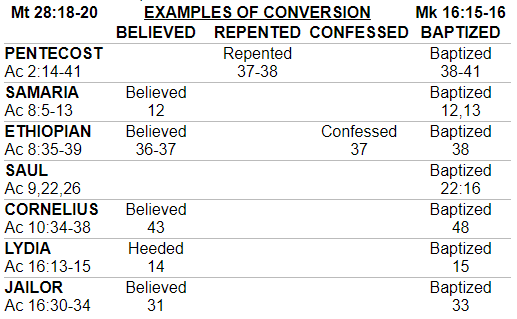
        2. In fact, in EVERY detailed example of conversion found in the Book of Acts, people were baptized after only one lesson! (see chart below)
    3. IN THE CONVERSION OF PAUL HIMSELF...
      1. Paul recounts his own conversion to the Lord - Ac 22:10-16
        1. He describes how he was told to go to Damascus, for there he would be told "all things appointed for you to do" ("what you must do" - cf. Ac 9:6)
        2. One of the things he was told was to be baptized without delay - Ac 22:16
      2. He was told to baptized in order to "wash away your sins"
        1. NOTE WELL: Despite seeing the Lord on the road to Damascus, having spent three days fasting and praying (Ac 9:9-11), he was STILL IN HIS SINS!
          1. Seeing the Lord had not saved him
          2. Accepting Jesus as Lord (cf. Ac 22:10) had not saved him
          3. Praying and fasting for three days had not saved him
        2. Not until he was baptized were his sins "washed away"! (exactly how we will examine later)
CONCLUSION
  1. That baptism played a prominent role in apostolic preaching becomes evident when we compare what is revealed in the examples of conversion...
  2. In every case of conversion described in detail in the book of Acts, baptism is mentioned...
    1. Clearly it is was an important theme of apostolic preaching
    2. G. R. Beasley-Murray, a Baptist scholar, has observed:
      "Baptism is...a part of the proclamation of Christ. In an Apostolic sermon it comes as its logical conclusion."
      - G.R. Beasley-Murray, Baptism In The New Testament, Grand Rapids: Wm. B. Eerdmans Publishing Co., 1962, p. 393)
  3. And what should be proclaimed regarding baptism? In this lesson we have seen...
    1. That it was commanded "for the remission of sins" - Ac 2:38
    2. That it was done to "wash away sins" - Ac 22:16
    3. That it involved "water" - Ac 8:36-38; 10:48
    4. That it was done "immediately", with no delay even if after midnight - Ac 16:25-33
  4. This would certainly suggest that baptism is necessary for salvation...
    1. But is this a fair conclusion drawn from the "preaching" of the apostles?
    2. Is this conclusion consistent with the "teaching" of the apostles, as found in their epistles?

Our next lesson will examine what the apostles taught in their epistles regarding baptism, as we continue to seek Bible answers to such questions...

Executable Outlines, Copyright © Mark A. Copeland, 2022

"BAPTISM" Baptism In The Teaching Of Paul by Mark Copeland


https://executableoutlines.com/topical_series/baptism/ba_02.html

"BAPTISM"

Baptism In The Teaching Of Paul

INTRODUCTION
  1. In our first lesson we saw where baptism played a prominent role in apostolic preaching...
    1. In every case of conversion described in the book of Acts, baptism is mentioned
    2. As G. R. Beasley-Murray, a Baptist scholar, observed: "Baptism is...a part of the proclamation of Christ. In an Apostolic sermon it comes as its logical conclusion." - G. R. Beasley-Murray, Baptism In The New Testament, Grand Rapids: Wm. B. Eerdmans Publishing Co., 1962, p. 393)
  2. And what did the apostles proclaim regarding baptism? We noticed that...
    1. It was commanded "for the remission of sins" - Ac 2:38
    2. It was done to "wash away sins" - Ac 22:16
    3. It involved "water" - Ac 8:36-38; 10:48
    4. It was done "immediately", with no delay even if after midnight - Ac 16:25-33
  3. This would certainly suggest that baptism is necessary for salvation...
    1. But is this a fair conclusion drawn from the "preaching" of the apostles?
    2. Is this conclusion consistent with the "teaching" of the apostles, as found in their epistles?

[In this lesson, we will examine what Paul taught in his epistles regarding baptism. Let's start with by noticing what he said about baptism...]

  1. IN HIS EPISTLE TO THE ROMANS
    1. BAPTISM IS A BURIAL AND RESURRECTION WITH CHRIST...
      1. It is a baptism into the death of Christ - Ro 6:3
      2. It is a burial with Christ into death (His death, we are crucified with Him!) - Ro 6:4
      3. It is done in order that we might walk in newness of life - Ro 6:4-5
      4. It involves crucifying the old man, that the body of sin may be destroyed - Ro 6:6
      5. It thereby frees us from sin as we die to sin, that we might live with Christ - Ro 6:7-11
    2. NOTE CAREFULLY...
      1. Paul does not say that baptism "symbolizes things which had already occurred"
        1. Many say this is the purpose or design of baptism, often quoting this passage
        2. But read the passage carefully; Paul says no such thing!
      2. But rather, Paul describes baptism into Christ as WHEN such things occur
        1. We were buried with Him "through baptism into death" - Ro 6:4
        2. It is in baptism we are buried with Christ into death (His death); we thereby die to sin in baptism
        3. We were buried with Him, why? "That just as Christ was raised...even so we also should walk in newness of life" - Ro 6:4
        4. We are baptized in order to rise to walk in newness of life just as Christ did!
      3. Note also Paul's preface to these remarks: "as many as were baptized into Christ Jesus were..."
        1. What blessings he describes pertain only to those who had been baptized!
        2. What of those not baptized? The blessings described would not apply!

        [In his commentary on Romans, Martin Luther wrote: "Baptism has been instituted that it should lead us to the blessings (of this death) and through such death to eternal life. Therefore IT IS NECESSARY that we should be baptized into Jesus Christ and His death." (Commentary On Romans, Kregel Publications, p.101).

        Though believing that we are justified by grace through faith (and he would say "by faith alone"), Luther understood that salvation by faith did not preclude the necessity of baptism! Why, we shall see shortly; but let's go on to consider what Paul wrote of baptism...]

  2. IN HIS EPISTLE TO THE GALATIANS
    1. BAPTISM IS HOW WE PUT ON CHRIST...
      1. From Ga 3:26-27 we learn that baptism is involved in the process of becoming sons of God by faith in Christ Jesus
      2. The "for" beginning verse 27 begins an explanation as to HOW we become sons of God through faith
      3. Baptism is therefore the means by which we "put on Christ", and become sons of God!
    2. NOTE CAREFULLY...
      1. Paul wrote: "For as many of you as were baptized into Christ have put on..."
        1. "For as many" means no more or no less
        2. Only those who have been baptized into Christ have really received Christ into their lives!
      2. Many teach "receive Jesus Christ by saying the sinner's prayer..."
        1. But the Bible nowhere teaches that this is how one "receives Christ"
        2. Rather, one "puts on" (or receives) Christ when they are baptized into Christ!

        [In his commentary on this verse, Luther concluded: "Wherefore baptism is a thing of great force and efficacy." (Commentary On Galatians, Kregel Publications, p.222). How true, if in baptism we "put on Christ"!

        How this is possible without being a form of works-salvation becomes clearer as we consider what Paul taught concerning baptism...]

  3. IN HIS EPISTLE TO THE COLOSSIANS
    1. BAPTISM IS A WORK OF GOD...
      1. A "spiritual circumcision" in which sins are "cut away" - Col 2:11
      2. A burial with Christ, and also a resurrection with Him - Col 2:12
      3. Made effective "through faith in the working of God" - Col 2:12
      4. In which GOD makes us "alive together with Him, having forgiven you all trespasses" - Col 2:13
    2. NOTE CAREFULLY...
      1. Here we learn that baptism is a work of God, not man
        1. Just as it was God who raised Jesus, so it is He who makes us alive, having forgiven our sins! - Col 2:13
        2. Our part is "faith in the working of God" as we are buried with Christ in baptism - Col 2:12
      2. God is the "Great Physician", who is cutting away our sins (through the blood of Christ)
        1. We are simply the patient, who humbly submits in faith to the surgeon's scalpel
        2. He is the One who makes us alive, that we might rise to walk in newness of life

    [Again, this is something Martin Luther clearly recognized, when he responded to those who would call this a kind of works-salvation:

    "Yes, it is true that our works are of no use for salvation. Baptism, however, is not our work but God's." (as quoted by Jack W. Cottrell in Baptism And The Remission of Sins, College Press, 1990, p. 32-34)

    Finally, let's consider what Paul taught concerning baptism...]

  4. IN HIS EPISTLE TO TITUS
    1. BAPTISM IS A "WASHING" AND "REGENERATION"...
      1. Is Paul talking about baptism in Tit 3:5?
        1. The figure "washing" certainly alludes to the baptismal waters
        2. We have already seen where in baptism we are:
          1. Raised to walk in newness of life - Ro 6:4
          2. Made alive by God - Col 2:12-13
          -- Does this not suggest a "washing of regeneration..."?
        3. Martin Luther and many others understood this verse to refer to baptism
      2. Thus God saves us in baptism:
        1. It is a "washing of regeneration" - a washing in we are reborn
        2. It is a "renewing of the Holy Spirit" - a renewal in which the Spirit is at work
        -- Just as Jesus said: "...unless one is born of water and the Spirit, he cannot enter the kingdom of God." - Jn 3:5
    2. NOTE CAREFULLY...
      1. This "washing" and "regeneration" does not occur because we have earned it!
        1. Baptism is not a work of righteousness by virtue of which we merit salvation!
        2. We are saved by the kindness, love, and mercy of God! - Tit 3:4-5
      2. It is by God's mercy that HE (not we) saves us!
        1. Which HE does through the washing of regeneration and renewing of the Holy Spirit!
        2. Which HE does when we are baptized into Christ!
      3. Through such mercy in Christ Jesus, we are truly "justified by His grace" - Tit 3:6-7
CONCLUSION
  1. Paul taught that baptism is...
    1. A burial into the death of Christ
    2. How we die to sin as we are crucified with Him
    3. A resurrection with Christ so we can rise to walk in newness of life
    4. A putting on Christ, thereby becoming a child of God
    5. A spiritual circumcision in which sins are cut away
    6. The working of God, whereby we are buried with Christ, made alive as our sins are forgiven, and then raised with Him
    7. An act of God's grace and mercy, in which we experience a washing of regeneration and renewal of the Holy Spirit
    -- If all these things when one is baptized, how can anyone say that it is not necessary?
  2. Sadly, many who say it is NOT necessary...
    1. Misunderstand those who say it is necessary
      1. Thinking that they believe in salvation by works
      2. When they truly believe in salvation by grace through faith!
    2. Misunderstand Martin Luther
      1. Whose coined phrased "saved by faith only" they themselves use so often
      2. When he differs with them on the necessity of baptism
    3. Misunderstand the apostle Paul
      1. Having him say things about the purpose of baptism he does not say
      2. Failing to appreciate what he clearly teaches about baptism
      -- All this, in their zeal to oppose what they mistakenly view as works-salvation!

In his commentary on Ga 3:27, Luther wrote:

"This is diligently to be noted, because of the fond and fantastical spirits, who go about to deface the majesty of baptism, and speak wickedly of it. Paul, contrariwise, commendeth it, and setteth it forth with honorable titles, calling it, 'the washing of regeneration, and renewing of the Holy Ghost'. And here also he saith, that 'all ye that are baptized into Christ, have put on Christ.' Wherefore baptism is a thing of great force and efficacy." (Commentary On Galatians, Kregel Publications, p. 222)
Do we deface the majesty of baptism, in our mistaken zeal to oppose what we perceive to be a form of works-salvation?

Or do we, like Paul, commend it by noting his own teaching regarding baptism, and like Luther, appreciate how that by the working of God it can be a thing of great force and efficacy?

Executable Outlines, Copyright © Mark A. Copeland, 2022

"BAPTISM" Baptism In The Teaching Of Peter by Mark Copeland


https://executableoutlines.com/topical_series/baptism/ba_03.html

"BAPTISM"

Baptism In The Teaching Of Peter

INTRODUCTION
  1. In our first lesson we saw where Peter included baptism as part of his apostolic preaching...
    1. He commanded the people at Pentecost to be baptized - Ac 2:36-38
    2. He commanded the household of Cornelius to be baptized - Ac 10:47-48
  2. From the accounts in Acts, we saw that for Peter baptism was...
    1. For the remission of sins - Ac 2:38
    2. An act that involved water - Ac 10:47
  3. But one might properly ask: was Peter teaching...
    1. That baptism was for the forgiveness of sins, and therefore necessary for salvation?
    2. That one is saved by baptism in water?
  4. Fortunately, we do not have wonder, for in his first epistle Peter wrote...
    "There is also an antitype which now saves us; baptism (not the removal of the filth of the flesh, but the answer of a good conscience toward God), through the resurrection of Jesus Christ," (1Pe 3:21)

[As stated in the KJV, "...baptism doth also NOW save us"! But while teaching that baptism saves us, Peter is careful to explain in what way. Let's take a closer look at the text to see what Peter is saying about baptism...]

  1. BAPTISM IS AN "ANTITYPE"
    1. DEFINING "ANTITYPE"...
      1. The Greek word is antitupon {an-teet'-oo-pon}, which means "a thing formed after some pattern; that which corresponds to a type"
      2. So you have two things that some how relate or correspond to each other; one is a type, the other is the antitype
    2. HOW BAPTISM IS AN ANTITYPE...
      1. In the text, the waters of the flood are the "type", and the waters of baptism are the "antitype" - 1Pe 3:20-21
      2. In his commentary, Albert Barnes says...
        1. "The meaning here is, that baptism corresponded to, or had a resemblance to, the water by which Noah was saved; or that there was a use of water in the one case which corresponded in some respects to the water that was used in the other; to wit, in effecting salvation." (Commentary on 1st Peter)
        2. "The apostle does not say that it corresponded in all respects; in respect, e.g., to quantity, or to the manner of the application, or to the efficacy; but there is a sense in which water performs an important part in our salvation, as it did in his." (ibid.)
      3. Thus Peter was comparing Noah's salvation with our own...
        1. Remember that Noah was saved by:
          1. Grace - Gen 6:8
          2. Faith - He 11:7
          3. Water - 1Pe 3:20
          -- Grace was God's part, faith was Noah's part; water was simply an element by which God carried out His plan to save Noah
        2. So we are saved by:
          1. Grace - Ep 2:5
          2. Faith - Ep 2:8
          3. Water - 1Pe 3:21
          -- Grace is God's part, faith is our part; baptism is simply an element by which God carries out His plan to save us through the blood of Christ

        [Because baptism in water is somehow related to our salvation, Peter could speak of it as an antitype that saves us, just as Noah and his family were "saved through water"!

        How can this be? Aren't we saved by the blood of Jesus? Of course! The answer can be seen as we continue to note what Peter taught concerning baptism...]

  2. BAPTISM SAVES THROUGH THE RESURRECTION OF CHRIST
    1. SALVATION IN BAPTISM IS NOT FOUND IN THE "WATER"...
      1. As Peter makes clear when he says "not the removal of the filth of the flesh"
      2. For indeed it is only through the blood of Jesus Christ one can be saved
        1. We are justified through His blood - Ro 5:9
        2. We have redemption through His blood, the forgiveness of sins - Ep 1:7
      3. To this Peter would definitely agree - 1Pe 1:18-19
    2. SALVATION IN BAPTISM IS POSSIBLE BECAUSE OF THE RESURRECTION OF CHRIST...
      1. If He had not been raised, we would still be in our sins
        1. As Paul declares in 1Co 15:17
        2. Without His resurrection, His death would have been meaningless
      2. But because Jesus was raised from the dead...
        1. Those baptized into His death can rise to walk in newness of life - Ro 6:4
        2. Those united together in the likeness of His death (i.e., baptism) can share in the power of His resurrection - Ro 6:5
      3. In other words, the same power of God that raised Jesus from the dead is what saves us in baptism so we can be "made alive" - cf. Col 2:12-13

      [By God's saving grace and resurrecting power, then, baptism can indeed save us! Not because of any cleansing power in the water, but because of what GOD is doing at that moment through the blood of Jesus and the regeneration of the Holy Spirit (cf. Tit 3:4-5).

      But notice finally, how Peter teaches that baptism saves because...]

  3. BAPTISM IS AN APPEAL FOR A GOOD CONSCIENCE
    1. "THE ANSWER OF A GOOD CONSCIENCE" (NKJV)
      1. A difficult phrase, but it most likely means "an appeal to God for a clear conscience"
      2. This is supported by the following translations:
        1. "the craving for a conscience right with God" (Goodspeed)
        2. "the prayer for a clean conscience before God" (Moffat)
        3. "the request unto God for a good conscience" (Rotherham)
        4. "an appeal to God for a clear conscience" (RSV)
        5. "an appeal to God for a good conscience" (NASV)
        -- Thus one is baptized because they desire a clear conscience (i.e., to have their sins forgiven)
    2. THIS COINCIDES WITH THE EVIDENT PURPOSE OF BAPTISM...
      1. In apostolic preaching, baptized was commanded:
        1. "For the remission of sins" - Ac 2:38
        2. To have one's sins "washed away" - cf. Ac 22:16
      2. In N.T. times people who realized they were sinners were anxious to be baptized as soon as possible - cf. Ac 8:35-38
      3. Therefore one is baptized...
        1. To have a good conscience before God; indeed, to have their conscience "purged" by the blood of Christ - cf. He 9:14
        2. To have their sins washed away by blood of Jesus and so they can rise to a new life through the same power of God that raised Jesus from the dead!
CONCLUSION
  1. Does baptism save us?
    1. Many say "Baptism does NOT save us!"
    2. But Peter clearly taught "...baptism doth also NOW save us" (KJV)
  2. How does baptism save us? According to Peter...
    1. Through the resurrection of Jesus Christ!
    2. As an appeal for a good conscience!
  3. This helps us to understand...
    1. Why he commanded it for the remission of sins - Ac 2:38
    2. Why he commanded it even for those who had in some sense received the Spirit - Ac 10:47-48

Yes, through the power of God that raised Jesus from the dead, working in conjunction with our faith in the blood of Jesus, baptism does indeed save those who are making an appeal for a clear conscience!

Is baptism essential to salvation? Let the preaching and teaching of Christ's apostles provide the answer! I believe that when we do, we can see why one should takes Jesus' own words with no equivocation:

"He who believes and is baptized will be saved; but he who does not believe will be condemned." - Mk 16:16

It is my prayer that if you have not yet properly responded to the Word of the Lord, you will heed the same words given to Paul:

"And now why are you waiting? Arise and be baptized, and wash away your sins, calling on the name of the Lord." - Ac 22:16

Have you made an appeal to God for a good conscience by being baptized into Christ?


Executable Outlines, Copyright © Mark A. Copeland, 2022

Does tattooing desecrate the body? by Roy Davison


http://www.oldpaths.com/Archive/Davison/Roy/Allen/1940/tattoos.html

Does tattooing desecrate the body?

“How sad when people desecrate their beautiful God-given bodies with tattoos.”

One brother objected when I made the above statement because people he loves have tattoos. I also love people with tattoos, which is why their tattoos make me sad.

First, although I will explain why a Christian should not get a tattoo, I wish to emphasize that there are fine, dedicated Christians who have tattoos as indelible marks of their former life. A tattoo is a permanent mutilation of the body. Thus, as one new Christian said, “When I was baptized my sins were washed away, but my tattoos are still there.” Another Christian comforted him, “Don’t worry! They will be gone in the resurrection!” Christians with indecent tattoos hide them from view if possible, of course.

Israel was told, “You shall not make any cuttings in your flesh for the dead, nor tattoo any marks on you: I am the LORD” (Leviticus 18:28).

What does this mean and does it apply to a Christian? Christians serve God under the New Covenant, not under the law of Moses. Thus, as a law, this does not apply to a Christian. “Whatever things were written before were written for our learning” (Romans 15:4), however, thus we must still ask if there are truths we can learn from this passage. And, are there teachings in the New Covenant that indirectly condemn getting a tattoo?

Some claim that Leviticus 18:28 relates only to idol worship and does not apply to tattoos in general. The verse itself, however, does not limit the condemnation to idol worship.

“In Leviticus 19:28 we find two prohibitions of an unnatural disfigurement of the body: ‘Ye shall not make any cutting in your flesh for the dead, nor print any marks upon you.’ The latter (Hebrew: qa aqa, incision) refers to tattooing, and has no reference to idolatrous usages, but was intended to inculcate upon the Israelites a proper reverence for God’s creation” (Merrill F. Unger, Unger’s Bible Dictionary, 1974 ed., p. 696).

“While ‘cuttings in the flesh’ have reference here to mourning customs [for the dead], the tattooing does not appear to pertain to such practice” (Wycliffe Bible Encyclopedia, 1975 ed., p. 1664).

Thus, from this passage we learn that God does not want us to mutilate our bodies.

The respect that we are to have for our bodies as Christians is raised to a higher level in the New Testament. “Or do you not know that your body is the temple of the Holy Spirit who is in you, whom you have from God, and you are not your own?” (1 Corinthians 6:19). The body of a Christian belongs to God! “I beseech you therefore, brethren, by the mercies of God, that you present your bodies a living sacrifice, holy, acceptable to God, which is your reasonable service” (Romans 12:1).

The body of a Christian is holy and ought not to be mutilated or subjected to needless harm.

Tattoos mutilate the body and make it vulnerable to infection. Each puncture of a tattoo needle involves a risk of acquiring blood-borne diseases.

Our skin provides protection against disease. A tattoo gun can puncture the skin up to 3000 times a minute. Each hole is about one millimeter deep and breaches the skin’s protective layer. A tattoo consists of thousands of puncture wounds into which insoluble ink has been injected.

“Tattooing poses health risks because the process exposes blood and body fluids. Because of this, a person who gets tattooed risks getting a disease or infection that is carried through blood. These blood-borne diseases include hepatitis B and C, tetanus, and HIV” (Bonnie B. Graves, Tattooing and body piercing, p. 40).

In 1991 Dr. Paul Fisher noticed among his patients an abnormally high amount of hepatitis C, a serious viral liver infection. By surveying 600 patients, he and Dr. Robert Haley discovered that the disease was being contracted through tattooing.

A Christian’s body belongs to God and ought not to be desecrated and subjected to needless risks by tattooing. Forgiveness is of course available to Christians who repent, but the mark will remain.
Roy Davison

The Scripture quotations in this article are from The New King James Version. ©1979, 1980, 1982, Thomas Nelson Inc., Publishers.

Published in The Old Paths Archive
(http://www.oldpaths.com)

“The Shame of Your Mother’s Nakedness”? Dave Miller, Ph.D.


https://apologeticspress.org/the-shame-of-your-mothers-nakedness/


Q:

Based on 1 Samuel 20:30, is it possible that Saul thought Jonathan was a homosexual?

A:

The passage in question reads: “Then Saul’s anger was aroused against Jonathan, and he said to him, ‘You son of a perverse, rebellious woman! Do I not know that you have chosen the son of Jesse to your own shame and to the shame of your mother’s nakedness?’” The word rendered “confusion” in the KJV is the normal Hebrew word for “shame.”1 It has the same latitude of meaning that our English word has. It does not include any hint of homosexuality. The word is used throughout the Old Testament to refer to the disgrace or shame that one experiences due to one’s own behavior, or the shame/disgrace brought upon a person by the behavior of another. See, for example, Jeremiah 2:26 where the prophet compares the shame of the caught thief to Israel’s shame due to her incessant involvement in idolatry. Or consider Bildad’s admonition to Job to admit his sin so that “Those who hate you will be clothed with shame” (Job 8:22). Regarding his enemies, David used a trilogy of synonyms in his request of God that they “be ashamed (bohsh) and brought to mutual confusion (chah-pher)” and “clothed with shame (boh-sheth) and dishonor” (Psalm 35:26). The word rendered “confusion” in the NKJV is rendered “confounded” in several other translations and means to “humiliate,” “embarrass,” “bewilder,” “baffle,” or “discomfit.” In the midst of national defeat, the psalmist moans: “My dishonor is continually before me, and the shame (boh-sheth) of my face has covered me.” Micah refers to the “naked shame” of the inhabitants of Shaphir (Micah 1:11). Hence, the word is even used of the mistreatment/shame that Jesus endured from His opponents: “You know my reproach, my shame, and my dishonor; My adversaries are all before You” (Psalm 69:19; cf. Acts 5:41). In a psalm that possesses Messianic overtones, God declares concerning the Messiah: “His enemies I will clothe with shame” (Psalm 132:18). Again, in all these instances, no reference is being made to anything sexual in nature.

The context, indeed, all of 1 Samuel and Saul’s 40-year reign, makes clear that Saul was upset about the threat that David posed to his own throne and, therefore, Jonathan’s prospects for becoming the next king. Saul considered David a serious rival to the throne (his own in particular). Spiritually-minded Jonathan demonstrated that he was perfectly submissive to God’s intention to make David the next king. Hence, “chosen” refers to Jonathan’s willingness to acquiesce to David’s right to the throne. Other translations render the word “siding with” (CSB), “allied yourself with” (CEB), “chosen to be loyal to” (CEV), “chosen to support” (ERV), “on the side of” (NCV), “you are choosing” (NASB). The NLT says it well: “Do you think I don’t know that you want him to be king in your place?” No hint of anything sexual is in the text. Further, the allusion to “your mother’s nakedness” is simply a Hebrew way to refer to a woman giving birth to a child. Hence, Saul was using a harsh insult to try to bully his son into siding with himself by suggesting that by siding with David, Jonathan was disgracing/shaming the mother who gave him birth.

Endnotes

1 Francis Brown, S.R. Driver, and Charles A. Briggs (1906), The Brown-Driver-Briggs Hebrew and English Lexicon (Peabody, MA: Hendrickson, 2004 reprint), p. 102.


Published

What it Means to Say “I’m Sorry”


https://thepreachersword.com/2012/02/17/learning-to-say-im-sorry/#more-706

SorryIm

Wendy Donahue, a staff writer for the Chicago Tribune, recently penned an article entitled “Give and take: The sport of apologizing.”  Our local Tampa Bay Times (TBT) picked it up.  While reading it, I was reminded of how difficult it is to simply say from the heart “I’m sorry.” It’s reminiscent of the 1976 hit by Elton John, when he crooned the mournful ballad “Sorry seems to be the hardest word.”

But it also occurred to me  how the word “sorry” seems to have changed its meaning and usage in our 21st century vocabulary. British journalist, Brandon O’Neill made this observation when he wrote, “These days, we use the word sorry not only to express sorrow for a misdemeanor, but also as an alternative to “pardon” (“Sorry, I didn’t quite catch that”) and “excuse me” (as in saying sorry when we bump into someone – or even, rather bizarrely, when they bump into us)”.

If we’re not careful saying, “I’m sorry” can become an overused euphemism that really lacks sincerity, or even speaks to an issue that merits an apology.

The words “sorry” and “sorrow” have a connection in origin and etymology. They share the idea of pain, suffering and distress.  Saying “I’m sorry” ought to be rooted in sorrow. Being sorry means to feel regret.  Compunction. Remorse.  Sorrow is an expression of grief, sadness or distress caused by a loss, disappointment or pain.

When the apostle Paul wrote the first letter to the Christians at Corinth he had to correct error and condemn sin in a very pointed manner.  The letter was effective and corrections were made.  So, in the second letter he wrote, “ Now I rejoice, not that you were made sorry, but that your sorrow led to repentance. For you were made sorry in a godly manner, that you might suffer loss from us in nothing” (2 Cor 7:9).

There are several things we can learn from this.

(1) Being sorry means to accept personal responsibility for wrong-doing.  An apology that blames others is not really an expression of guilt or regret.

(2) Being sorry should be the result of godly sorrow.  We’ve all heard apologies that sounded contrived or coerced.  Sometimes people are sorry they got caught.  That kind of sorrow is a carnal sorrow, not a godly sorrow.

(3) Being sorry should lead to repentance.  To repent is to change. To correct one’s course.  To make amends.  It is a change of heart that results in a change of behavior.  To say you are sorry, but to continue engaging in the same hurtful actions is insincere and hypocritical.

A couple of other thoughts may be appropriate to effective apology.  When possible apologize in person.  Not by phone. Email. Letter. Or Text.  There is something efficacious about looking someone in the eye and saying, “I’m sorry.”  Don’t make excuses by blaming someone else or circumstances.  Avoid any “apology” the begins, “I’m sorry, but..”  Or I’m sorry, if….”  You know where those sentence are going!

Ali McGraw’s character in the classic movie Love Story is  famous for saying, “Love means never having to say you’re sorry.”  That may have sounded romantic in the movie, but quite the opposite is true.  Real life is about relationships where people make mistakes, use poor judgment, forget, or even sin.  And such actions always impact someone we love. Family. Friends. Neighbors. Or brethren.   So be willing to apologize.  Simply.  Sincerely.  Succinctly.  Because true love is always willing to say, “I’m sorry.”