January 10, 2022

Does tattooing desecrate the body? by Roy Davison


http://www.oldpaths.com/Archive/Davison/Roy/Allen/1940/tattoos.html

Does tattooing desecrate the body?

“How sad when people desecrate their beautiful God-given bodies with tattoos.”

One brother objected when I made the above statement because people he loves have tattoos. I also love people with tattoos, which is why their tattoos make me sad.

First, although I will explain why a Christian should not get a tattoo, I wish to emphasize that there are fine, dedicated Christians who have tattoos as indelible marks of their former life. A tattoo is a permanent mutilation of the body. Thus, as one new Christian said, “When I was baptized my sins were washed away, but my tattoos are still there.” Another Christian comforted him, “Don’t worry! They will be gone in the resurrection!” Christians with indecent tattoos hide them from view if possible, of course.

Israel was told, “You shall not make any cuttings in your flesh for the dead, nor tattoo any marks on you: I am the LORD” (Leviticus 18:28).

What does this mean and does it apply to a Christian? Christians serve God under the New Covenant, not under the law of Moses. Thus, as a law, this does not apply to a Christian. “Whatever things were written before were written for our learning” (Romans 15:4), however, thus we must still ask if there are truths we can learn from this passage. And, are there teachings in the New Covenant that indirectly condemn getting a tattoo?

Some claim that Leviticus 18:28 relates only to idol worship and does not apply to tattoos in general. The verse itself, however, does not limit the condemnation to idol worship.

“In Leviticus 19:28 we find two prohibitions of an unnatural disfigurement of the body: ‘Ye shall not make any cutting in your flesh for the dead, nor print any marks upon you.’ The latter (Hebrew: qa aqa, incision) refers to tattooing, and has no reference to idolatrous usages, but was intended to inculcate upon the Israelites a proper reverence for God’s creation” (Merrill F. Unger, Unger’s Bible Dictionary, 1974 ed., p. 696).

“While ‘cuttings in the flesh’ have reference here to mourning customs [for the dead], the tattooing does not appear to pertain to such practice” (Wycliffe Bible Encyclopedia, 1975 ed., p. 1664).

Thus, from this passage we learn that God does not want us to mutilate our bodies.

The respect that we are to have for our bodies as Christians is raised to a higher level in the New Testament. “Or do you not know that your body is the temple of the Holy Spirit who is in you, whom you have from God, and you are not your own?” (1 Corinthians 6:19). The body of a Christian belongs to God! “I beseech you therefore, brethren, by the mercies of God, that you present your bodies a living sacrifice, holy, acceptable to God, which is your reasonable service” (Romans 12:1).

The body of a Christian is holy and ought not to be mutilated or subjected to needless harm.

Tattoos mutilate the body and make it vulnerable to infection. Each puncture of a tattoo needle involves a risk of acquiring blood-borne diseases.

Our skin provides protection against disease. A tattoo gun can puncture the skin up to 3000 times a minute. Each hole is about one millimeter deep and breaches the skin’s protective layer. A tattoo consists of thousands of puncture wounds into which insoluble ink has been injected.

“Tattooing poses health risks because the process exposes blood and body fluids. Because of this, a person who gets tattooed risks getting a disease or infection that is carried through blood. These blood-borne diseases include hepatitis B and C, tetanus, and HIV” (Bonnie B. Graves, Tattooing and body piercing, p. 40).

In 1991 Dr. Paul Fisher noticed among his patients an abnormally high amount of hepatitis C, a serious viral liver infection. By surveying 600 patients, he and Dr. Robert Haley discovered that the disease was being contracted through tattooing.

A Christian’s body belongs to God and ought not to be desecrated and subjected to needless risks by tattooing. Forgiveness is of course available to Christians who repent, but the mark will remain.
Roy Davison

The Scripture quotations in this article are from The New King James Version. ©1979, 1980, 1982, Thomas Nelson Inc., Publishers.

Published in The Old Paths Archive
(http://www.oldpaths.com)

“The Shame of Your Mother’s Nakedness”? Dave Miller, Ph.D.


https://apologeticspress.org/the-shame-of-your-mothers-nakedness/


Q:

Based on 1 Samuel 20:30, is it possible that Saul thought Jonathan was a homosexual?

A:

The passage in question reads: “Then Saul’s anger was aroused against Jonathan, and he said to him, ‘You son of a perverse, rebellious woman! Do I not know that you have chosen the son of Jesse to your own shame and to the shame of your mother’s nakedness?’” The word rendered “confusion” in the KJV is the normal Hebrew word for “shame.”1 It has the same latitude of meaning that our English word has. It does not include any hint of homosexuality. The word is used throughout the Old Testament to refer to the disgrace or shame that one experiences due to one’s own behavior, or the shame/disgrace brought upon a person by the behavior of another. See, for example, Jeremiah 2:26 where the prophet compares the shame of the caught thief to Israel’s shame due to her incessant involvement in idolatry. Or consider Bildad’s admonition to Job to admit his sin so that “Those who hate you will be clothed with shame” (Job 8:22). Regarding his enemies, David used a trilogy of synonyms in his request of God that they “be ashamed (bohsh) and brought to mutual confusion (chah-pher)” and “clothed with shame (boh-sheth) and dishonor” (Psalm 35:26). The word rendered “confusion” in the NKJV is rendered “confounded” in several other translations and means to “humiliate,” “embarrass,” “bewilder,” “baffle,” or “discomfit.” In the midst of national defeat, the psalmist moans: “My dishonor is continually before me, and the shame (boh-sheth) of my face has covered me.” Micah refers to the “naked shame” of the inhabitants of Shaphir (Micah 1:11). Hence, the word is even used of the mistreatment/shame that Jesus endured from His opponents: “You know my reproach, my shame, and my dishonor; My adversaries are all before You” (Psalm 69:19; cf. Acts 5:41). In a psalm that possesses Messianic overtones, God declares concerning the Messiah: “His enemies I will clothe with shame” (Psalm 132:18). Again, in all these instances, no reference is being made to anything sexual in nature.

The context, indeed, all of 1 Samuel and Saul’s 40-year reign, makes clear that Saul was upset about the threat that David posed to his own throne and, therefore, Jonathan’s prospects for becoming the next king. Saul considered David a serious rival to the throne (his own in particular). Spiritually-minded Jonathan demonstrated that he was perfectly submissive to God’s intention to make David the next king. Hence, “chosen” refers to Jonathan’s willingness to acquiesce to David’s right to the throne. Other translations render the word “siding with” (CSB), “allied yourself with” (CEB), “chosen to be loyal to” (CEV), “chosen to support” (ERV), “on the side of” (NCV), “you are choosing” (NASB). The NLT says it well: “Do you think I don’t know that you want him to be king in your place?” No hint of anything sexual is in the text. Further, the allusion to “your mother’s nakedness” is simply a Hebrew way to refer to a woman giving birth to a child. Hence, Saul was using a harsh insult to try to bully his son into siding with himself by suggesting that by siding with David, Jonathan was disgracing/shaming the mother who gave him birth.

Endnotes

1 Francis Brown, S.R. Driver, and Charles A. Briggs (1906), The Brown-Driver-Briggs Hebrew and English Lexicon (Peabody, MA: Hendrickson, 2004 reprint), p. 102.


Published

What it Means to Say “I’m Sorry”


https://thepreachersword.com/2012/02/17/learning-to-say-im-sorry/#more-706

SorryIm

Wendy Donahue, a staff writer for the Chicago Tribune, recently penned an article entitled “Give and take: The sport of apologizing.”  Our local Tampa Bay Times (TBT) picked it up.  While reading it, I was reminded of how difficult it is to simply say from the heart “I’m sorry.” It’s reminiscent of the 1976 hit by Elton John, when he crooned the mournful ballad “Sorry seems to be the hardest word.”

But it also occurred to me  how the word “sorry” seems to have changed its meaning and usage in our 21st century vocabulary. British journalist, Brandon O’Neill made this observation when he wrote, “These days, we use the word sorry not only to express sorrow for a misdemeanor, but also as an alternative to “pardon” (“Sorry, I didn’t quite catch that”) and “excuse me” (as in saying sorry when we bump into someone – or even, rather bizarrely, when they bump into us)”.

If we’re not careful saying, “I’m sorry” can become an overused euphemism that really lacks sincerity, or even speaks to an issue that merits an apology.

The words “sorry” and “sorrow” have a connection in origin and etymology. They share the idea of pain, suffering and distress.  Saying “I’m sorry” ought to be rooted in sorrow. Being sorry means to feel regret.  Compunction. Remorse.  Sorrow is an expression of grief, sadness or distress caused by a loss, disappointment or pain.

When the apostle Paul wrote the first letter to the Christians at Corinth he had to correct error and condemn sin in a very pointed manner.  The letter was effective and corrections were made.  So, in the second letter he wrote, “ Now I rejoice, not that you were made sorry, but that your sorrow led to repentance. For you were made sorry in a godly manner, that you might suffer loss from us in nothing” (2 Cor 7:9).

There are several things we can learn from this.

(1) Being sorry means to accept personal responsibility for wrong-doing.  An apology that blames others is not really an expression of guilt or regret.

(2) Being sorry should be the result of godly sorrow.  We’ve all heard apologies that sounded contrived or coerced.  Sometimes people are sorry they got caught.  That kind of sorrow is a carnal sorrow, not a godly sorrow.

(3) Being sorry should lead to repentance.  To repent is to change. To correct one’s course.  To make amends.  It is a change of heart that results in a change of behavior.  To say you are sorry, but to continue engaging in the same hurtful actions is insincere and hypocritical.

A couple of other thoughts may be appropriate to effective apology.  When possible apologize in person.  Not by phone. Email. Letter. Or Text.  There is something efficacious about looking someone in the eye and saying, “I’m sorry.”  Don’t make excuses by blaming someone else or circumstances.  Avoid any “apology” the begins, “I’m sorry, but..”  Or I’m sorry, if….”  You know where those sentence are going!

Ali McGraw’s character in the classic movie Love Story is  famous for saying, “Love means never having to say you’re sorry.”  That may have sounded romantic in the movie, but quite the opposite is true.  Real life is about relationships where people make mistakes, use poor judgment, forget, or even sin.  And such actions always impact someone we love. Family. Friends. Neighbors. Or brethren.   So be willing to apologize.  Simply.  Sincerely.  Succinctly.  Because true love is always willing to say, “I’m sorry.”

Entangled? by Gary Rose


Spider webs, just an ordinary everyday thing. This one is a bit different in that it is coated in moisture, making it look like an intricate web of pearls. Most spider webs aren’t like this one, however. They have no coating and many times are invisible, which is quite an advantage to catching prey. Prey is not all they catch, however. As I leave my house and go past my truck at the end of the carport, I occasionally encounter one an quickly shrug it off. Nasty things, SPIDER WEBS!


As I think about it, spider webs are like sin; if you don’t avoid them, you can become entangled. For humans, it is an inconvenience, but if you were a fly, welcome to a very bad day.


So, how do humans become entangled in sin? I think its because they just don’t want to see sin and refuse to believe it can affect them. Instead of just following the good way God has designed for them, people just do what they want and suffer the consequences.


The Apostle Paul says…

Romans 1 ( World English Bible )


13 Now I don’t desire to have you unaware, brothers, that I often planned to come to you, and was hindered so far, that I might have some fruit among you also, even as among the rest of the Gentiles.

14 I am debtor both to Greeks and to foreigners, both to the wise and to the foolish.

15 So, as much as is in me, I am eager to preach the Good News to you also who are in Rome.

16 For I am not ashamed of the Good News of Christ, for it is the power of God for salvation for everyone who believes; for the Jew first, and also for the Greek.

17 For in it is revealed God’s righteousness from faith to faith. As it is written, “But the righteous shall live by faith.”

18 For the wrath of God is revealed from heaven against all ungodliness and unrighteousness of men, who suppress the truth in unrighteousness,

19 because that which is known of God is revealed in them, for God revealed it to them.

20 For the invisible things of him since the creation of the world are clearly seen, being perceived through the things that are made, even his everlasting power and divinity; that they may be without excuse.

21 Because, knowing God, they didn’t glorify him as God, neither gave thanks, but became vain in their reasoning, and their senseless heart was darkened.

22 Professing themselves to be wise, they became fools,

23 and traded the glory of the incorruptible God for the likeness of an image of corruptible man, and of birds, and four-footed animals, and creeping things.

24 Therefore God also gave them up in the lusts of their hearts to uncleanness, that their bodies should be dishonored among themselves,

25 who exchanged the truth of God for a lie, and worshiped and served the creature rather than the Creator, who is blessed forever. Amen.

26 For this reason, God gave them up to vile passions. For their women changed the natural function into that which is against nature.

27 Likewise also the men, leaving the natural function of the woman, burned in their lust toward one another, men doing what is inappropriate with men, and receiving in themselves the due penalty of their error.

28 Even as they refused to have God in their knowledge, God gave them up to a reprobate mind, to do those things which are not fitting;

29 being filled with all unrighteousness, sexual immorality, wickedness, covetousness, malice; full of envy, murder, strife, deceit, evil habits, secret slanderers,

30 backbiters, hateful to God, insolent, haughty, boastful, inventors of evil things, disobedient to parents,

31 without understanding, covenant breakers, without natural affection, unforgiving, unmerciful;

32 who, knowing the ordinance of God, that those who practice such things are worthy of death, not only do the same, but also approve of those who practice them.


The good way is from God, the destructive way is from the devil. Simple concept, which millions of millions of people ignore to their own ultimate destruction.


Why? Simply put- they don’t want to obey and live. Sin, like the spiders web, will entangle you, control you and ultimately destroy you. God’s gospel of grace is the way to salvation from sin, the only way out.


I would rather obey and live. How about you?


January 3, 2022

January Bible Reading by Gary Rose


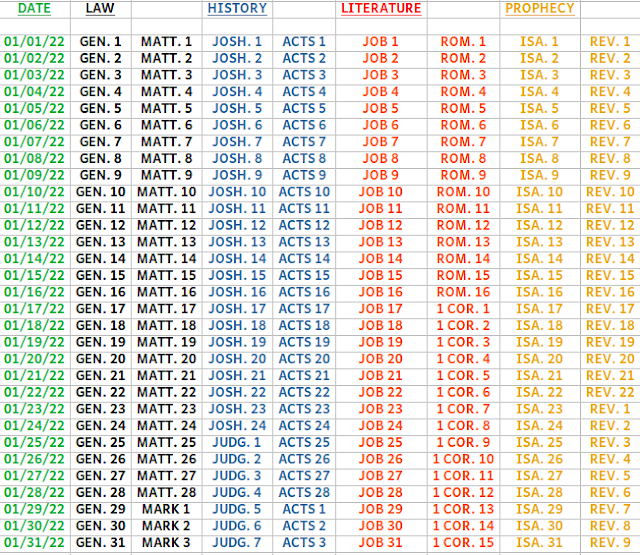
January Categorical Bible Reading


Did you ever find yourself reading just your favorite books and ignoring the ones that just do not seem that interesting to you? Well, then, you just might like to try reading the Bible by category. If you read all four categories for both testaments that may be a bit much for most people (eight chapters a day).

I am reading two categories this year ( Law and Literature [ both testaments ] ). Since the individual categories do not last a full year, they are read repetitively. 

I will be presenting a spreadsheet printout like the above for each month.

I pray that you will find this method useful!

Gary Rose


Living with Enthusiasm by Ken Weliever, The Preacherman

https://thepreachersword.com/category/zeal/

Living with Enthusiasm

Curtis Jones relates the legend of  a wealthy merchant traveling through the Mediterranean world looking for the distinguished Pharisee, Paul.  In time he encountered Timothy, who arranged for a visit. Paul was, at the time, a prisoner in Rome. Stepping inside the cell, the merchant was surprised to find a rather old man, physically frail, but whose serenity and magnetism challenged the visitor. They talked for hours. Finally the merchant left with Paul’s blessing. Outside the prison, the concerned man inquired, “What is the secret of this man’s power? I have never seen anything like it before.”
Did you not guess?” replied Timothy. “Paul is in love.”
The merchant looked bewildered. “In Love?”
“Yes,” the missionary answered, “Paul is in love with Jesus Christ.”
The merchant looked even more bewildered. “Is that all?”
Smiling, Timothy replied, “Sir, that is everything.”

While this story is undoubtedly a myth, it certainly fits the persona and personality of Paul as presented in Scripture. He was a man of zeal.  Passion. Enthusiasm.  Even prior to becoming a Christian he was zealous for the traditions of Judaism (Gal.1:14)  passionate about persecuting Christians (Phil. 3:6).  Following his conversion he channeled that zeal into preaching Christ.  Yes, Paul was in love with Christ!

I wonder with so many distractions in our world today, with so many things that clamor for our time and attention, and with so many secular interests, if we have the kind of fervor that Christianity requires?  Are we zealous?  Passionate?  Dare I say, in love with Jesus?

This year’s NFL season will be remembered as much for the controversy and conversation about Tim Tebow as it will the eventual Super Bowl champion.  Whether one thinks Tebow will ever be a great NFL quarterback, or even agrees with the statements regarding his religious belief in Jesus, one thing is for sure, he is passionate about his faith, and unashamed to enthusiastically let others know where he stands. Christians in the stands cheering might do well to take a page from his book.

“Every great and commanding movement in the annals of the world, wrote Emerson, “is the triumph of enthusiasm.  Nothing great was ever achieved without it.” That’s why Paul would admonish us, “And whatever you do, do it heartily, as to the Lord and not to men,  knowing that from the Lord you will receive the reward of the inheritance; for you serve the Lord Christ” (Col.3:23-24).  This was actually spoken to slaves in regard to their work for their masters.  Yes, you can be enthusiastic for the Lord, and glorify him in your job!

In fact, the word “enthusiasm” comes from the Greek “en theos” which means “God in us.” All human beings are created in the image of God.  But as Christians we have a spark of the divine nature.  If there is any group of people in the world that ought to be positive, progressive and enthusiastic, it should be Christians!

And so today, this week, let us resolve to serve the Lord with passion. Zeal. Enthusiasm.  And to do so wherever we are and whatever we are doing.  At work. At school.  In our home lives. In our community efforts. And certainly in our worship and in our church family.

In the final analysis enthusiasm, as Henry Chester expressed it, “ is nothing more or less than faith in action.”  And it is that passionate faith that leads to achievement in this life. And in the life to come.

Keys Promised to Peter by David Vaughn Elliott


Keys Promised to Peter by David Vaughn Elliott


http://steve-finnell.blogspot.com/2017/


Keys Promised to Peter
by David Vaughn Elliott

He who holds keys controls entry. Is Peter standing at the gates of heaven, deciding who enters? No, that is just sacrilegious joke material. Well then, will Peter be standing at the gates of a future millennium reign of Christ, deciding who enters? I never heard of any premillennialist teaching that. 

What, then, is Jesus telling Peter in Matthew 16:18,19? "I will build My church... I will give you the keys of the kingdom of heaven, and whatever you bind on earth will be bound in heaven." Notice 1) In practically the same breath, with no hint of changing subjects, Jesus speaks of the church and the kingdom, apparently equating them. 2) Peter would use the keys to bind "on earth," thus it was to be done during his lifetime. 

Since Jesus does not fail, His promises amount to prophecy.  Thus this is a prophecy about the kingdom. The prophecy says that Peter will open the way into the kingdom and that he will make binding decrees regarding the kingdom. Even futurist-premillennialists apply this prophecy to Peter's earthly ministry beginning on the day of Pentecost. Thus they inadvertently confess that the church is the kingdom and that the kingdom of God began on the day of Pentecost in the year 30 A.D. 

Since Jesus promised Peter "the keys of the kingdom," it is no coincidence that Peter was the leading spokesman on the day of Pentecost. Keys open doors. Once open, others can enter. Thus, Christ designated Peter to unlock the doors, telling people how they could enter the kingdom: "Repent, and be baptized every one of you in the name of Jesus Christ for the remission of sins, and you shall receive the gift of the Holy Spirit" (Acts 2:38). The doors of the kingdom have been open for 2000 years. Those who listen to the holder of the keys are privileged to enter.

"AM I MY BROTHER'S KEEPER?" Genesis 4:9 by Mark Copeland


"AM I MY BROTHER'S KEEPER?"

Genesis 4:9

INTRODUCTION
  1. Perhaps one of the more thought-provoking questions in the Bible is that one asked by Cain:
    1. Cain had killed his brother because God had accepted Abel's offering, but not his own - Gen 4:3-8
    2. When the Lord inquired concerning Abel, Cain's response was:
      "Am I my brother's keeper?" (Gen 4:9)
  2. This is a question we would do well to ask ourselves today...
    1. Are we our brother's keeper?
    2. Do we have a responsibility to watch out for and care for one another?

[When one turns to the New Testament, it becomes clear that the answer is in the affirmative. In fact, there are many passages which emphasize...]

  1. OUR RESPONSIBILITIES TO ONE ANOTHER
    1. WE ARE TO "LOVE ONE ANOTHER"...
      1. As commanded by Jesus - Jn 13:34-35; 15:12,17
      2. As taught by Paul - Ro 13:8; 1Th 4:9
      3. As instructed by Peter - 1Pe 1:22
      4. As stressed by John - 1Jn 3:11 (note v.12), 23; 4:7,11-12; 2Jn 5
      -- But how are we to express such love? Other passages can provide the answer...
    2. HOW WE SHOW OUR LOVE FOR ONE ANOTHER...
      1. We are to "receive one another" - Ro 15:7
      2. We are to "edify another" - Ro 14:19
      3. We are to "serve one another" - Ga 5:13
      4. We are to "bear one another's burdens" - Ga 6:1-2
      5. We are to be "forgiving one another" - Ep 4:32
      6. We are to be "submitting to one another" - Ep 5:21
      7. We are to "exhort one another" - He 3:12-13
      8. We are to "consider one another" - He 10:24-25
      9. We are to be "hospitable to one another" - 1Pe 4:8-10

      [In light of such "one another" passages, is there any doubt that we are to be our brother's keeper?

      But how well are we doing? To stimulate our thinking and help us re-examine how well we are fulfilling our obligations to one another, consider the following questions...]

  2. EVALUATING OUR ROLE AS OUR BROTHER'S KEEPER
    1. WHEN ONE BECOMES A BROTHER...
      1. Do we receive them into the family of God, or ignore them? - Ro 15:7
        1. Are they properly assimilated in the family life of the congregation?
        2. Do they remain on the fringe?
        -- If we do not even know their names, we can be sure that we are failing as our brother's keeper!
      2. Do we edify them, or put stumblingblocks in their way? - Ro 14:19
        1. As individuals, are we "body-builders", encouraging the members of the body?
        2. Or are we like a cancer, weakening the members of the body of Christ?
          1. By our own example
          2. By our words, attitudes, etc.
          -- It was said of Philemon that he refreshed the hearts of the brethren; do people say the same of us?
      3. Do we submit to them, or arrogantly rule over them? - Ep 5:21
      4. Do we serve them in love, or expect them to serve us? - Ga 5:13
      5. Do we demonstrate hospitality to them? - 1Pe 4:8-10
        1. By visiting them in their need?
        2. By inviting them into your home (or accepting invitations to their home)?
    2. WHEN A BROTHER IS OVERTAKEN IN A FAULT...
      1. Do we even consider them? - He 10:24-25
        1. Are we even aware of who they are?
        2. Are we ignorant of their problems? If so, why?
          1. Maybe it is because we don't assemble enough ourselves
          2. We may "wonder about them", but that is not sufficient!
        3. Do they drift away, with no one making an effort to reach them?
      2. Do we exhort them, lest they become hardened by sin? - He 3:12-14
        1. Or are we afraid to confront them, for fear of running them away?
          1. If we truly love them and approach them with humility, they are not likely to run away
          2. If they do, they are running away from God, not you!
        2. Remember, such exhortation is to be daily! Perhaps we wait too long...
      3. Are we willing bear their burdens? - Ga 6:1-2
        1. So as to help them overcome and become stronger
        2. Or do we rather not be bothered?
      4. Are we quick to forgive them when they repent? - Ep 4:32
        1. Fear of not being forgiven and accepted back into the family may keep some from repenting and returning to the fold
        2. Do we communicate a willingness to accept with open arms and offer complete forgiveness?
CONCLUSION
  1. How we answer such questions may reveal how well or poorly we are...
    1. Fulfilling our responsibility to be our brother's keeper
    2. Living up to the one responsibility we have that includes all others: to love one another as Christ loved us - Jn 13:34-35
  2. If we have failed to be our brother's keeper, we need to...
    1. Repent of our lack of concern, our inactivity, or whatever has hindered us
    2. Confess our shortcomings in this area to God
    3. Resolve to apply with zeal these "one another" passages!

Are you your brother's keeper? Are you even identified with a congregation whereby you can be a working member who both cares for those in the family, and be cared for by them?

I hope this study has stimulated your thinking about responsibilities you have toward your brethren in Christ...

Executable Outlines, Copyright © Mark A. Copeland, 2022

Blessing by Gary Rose


Today, as I perused FACEBOOK, I noticed that brother Ed Healy ( who was a former classmate of mine at Northeast School of Biblical Studies ) had made a new webpage. A short time later, I saw this “Peanuts” blessing and thought of brother Ed because of his Celtic heritage ( which this “Peanuts” blessing seems to say as well ).


And I thought how much a greeting can say about a person; what they are like, what they believe, how they act, etc.. To this end I chose three greeting from Paul, one to the Roman congregation and two to the Corinthian group of Christians.


The Bible says...


Romans 1 ( World English Bible )

1 Paul, a servant of Jesus Christ, called to be an apostle, set apart for the Good News of God,

2 which he promised before through his prophets in the holy Scriptures,

3 concerning his Son, who was born of the seed of David according to the flesh,

4 who was declared to be the Son of God with power, according to the Spirit of holiness, by the resurrection from the dead, Jesus Christ our Lord,

5 through whom we received grace and apostleship, for obedience of faith among all the nations, for his name’s sake;

6 among whom you are also called to belong to Jesus Christ;

7 to all who are in Rome, beloved of God, called to be saints: Grace to you and peace from God our Father and the Lord Jesus Christ.

8 First, I thank my God through Jesus Christ for all of you, that your faith is proclaimed throughout the whole world.

9 For God is my witness, whom I serve in my spirit in the Good News of his Son, how unceasingly I make mention of you always in my prayers,

10 requesting, if by any means now at last I may be prospered by the will of God to come to you.

11 For I long to see you, that I may impart to you some spiritual gift, to the end that you may be established;

12 that is, that I with you may be encouraged in you, each of us by the other’s faith, both yours and mine.


1 Corinthians 1 ( WEB )

1 Paul, called to be an apostle of Jesus Christ through the will of God, and our brother Sosthenes,

2 to the assembly of God which is at Corinth; those who are sanctified in Christ Jesus, called to be saints, with all who call on the name of our Lord Jesus Christ in every place, both theirs and ours:

3 Grace to you and peace from God our Father and the Lord Jesus Christ.

4 I always thank my God concerning you, for the grace of God which was given you in Christ Jesus;

5 that in everything you were enriched in him, in all speech and all knowledge;

6 even as the testimony of Christ was confirmed in you:

7 so that you come behind in no gift; waiting for the revelation of our Lord Jesus Christ;

8 who will also confirm you until the end, blameless in the day of our Lord Jesus Christ.

9 God is faithful, through whom you were called into the fellowship of his Son, Jesus Christ, our Lord.


2 Corinthians 1 ( WEB )

1 Paul, an apostle of Christ Jesus through the will of God, and Timothy our brother, to the assembly of God which is at Corinth, with all the saints who are in the whole of Achaia:

2 Grace to you and peace from God our Father and the Lord Jesus Christ.

3 Blessed be the God and Father of our Lord Jesus Christ, the Father of mercies and God of all comfort;

4 who comforts us in all our affliction, that we may be able to comfort those who are in any affliction, through the comfort with which we ourselves are comforted by God.

5 For as the sufferings of Christ abound to us, even so our comfort also abounds through Christ.

6 But if we are afflicted, it is for your comfort and salvation. If we are comforted, it is for your comfort, which produces in you the patient enduring of the same sufferings which we also suffer.

7 Our hope for you is steadfast, knowing that, since you are partakers of the sufferings, so also are you of the comfort.


After reading these again, several things stood out.

1. In all these greetings Paul had the recipients best interests at heart.

2. Paul knew them well and encouraged them in their faith.

3. To the Corinthians, he lists others along with him as well-wishers.

4. These letters were not form letters; each was specific to their needs.


Today, it is easy to stay in-touch with others; the social media options are legion. Question: have we lost touch with how personal communication with our fellow Christians can and should be?

2022 is a new year, with new possibilities. Why not determine to build up our brethren in Christ in every possible way? What a nice way to begin a new year, showing love and concern for others!


December 30, 2021

"THE APOSTASY AND RESTORATION" by Mark Copeland

"THE APOSTASY AND RESTORATION"

INTRODUCTION
  1. The New Testament reveals the establishment and early growth of the church...
    1. The church Jesus said He would build - Mt 16:18
    2. The church Paul wrote that Jesus loved - Ep 5:25-27
  2. The Lord's will is that there be one church...
    1. He prayed for the unity of His followers - Jn 17:20-23
    2. Paul later wrote that there is one body (i.e., church) - Ep 4:4-6; cf. Ep 1:22-23
  3. Yet we see around us so much religious confusion, so many different churches...
    1. How did it happen?
    2. What can disciples of Christ today do about it?

[In the first place, we really should not be surprised by the plethora of different churches. For in the Bible itself we read that there would be an "apostasy" (falling away)...]

  1. THE APOSTASY FORETOLD
    1. BY THE APOSTLE PAUL...
      1. In warning the Ephesian elders - Ac 20:27-31
        1. Of "wolves" coming in from outside the flock
        2. Of men "from among yourselves" drawing disciples away
      2. In warning the church at Thessalonica - 2Th 2:1-3
        1. Of a great "falling away" that must come
        2. Revealing "the man of sin", "the son of perdition"
      3. In warning the evangelist Timothy - 1Ti 4:1-3; 2Ti 4:1-4
        1. Describing how some will "depart from the faith"
          1. Giving heed to "deceiving spirits and doctrines of demons"
          2. Forbidding to marry, commanding to abstain from meats
        2. Describing how some will "not endure sound doctrine"
          1. Getting teachers who will tell them what they want to hear
          2. Turning from the truth, turning aside to fables
    2. BY PETER, JUDE, AND JOHN...
      1. Peter warned of false teachers to come - 2Pe 2:1-2
        1. Who will bring in destructive heresies
        2. Whom many will follow
      2. Jude warned of false teachers who were present - Jude 3-4
        1. Who had crept in unnoticed
        2. Who were turning the grace of God into lewdness
        3. Who were denying the Lord God and the Lord Jesus Christ
      3. John warned of "antichrists" who had come - 1Jn 2:18-19
        1. Many, in fact, had come!
        2. Indicative of living in the "last hour"

        [As Jesus had warned, there would be false prophets (Mt 7:15). Before the canon of the New Testament was completed, the apostasy was already underway. As one examines early church history, there are further indications of...]

  2. THE APOSTASY FULFILLED
    1. A GRADUAL PROCESS...
      1. In many cases, innocent at first
        1. Attempting to deal with errors in and out of the church
        2. Leading to a change in the organization of the church
          1. From autonomous and independent congregations overseen by a plurality of elders (also known as bishops and pastors) - cf. Ac 14:23; 20:17,28; 1Pe 5:1-2
          2. To a collectivity of churches under one bishop - e.g., Ignatius
        3. Resulting in centralization of power and influence among key individuals
      2. This subtle change made it much easier for error to spread
        1. When those in power began teaching false doctrine
        2. Before long, the very errors foretold by Paul were being taught - cf. 1Ti 4:1-3
      3. Through slow but gradual changes, the seeds of modern churches were sown
        1. Producing what later became known as the Roman Catholic Church
        2. But also many other "orthodox" churches (Greek, Egyptian, Russian, Armenian, etc.)
        -- Just as foretold, many departed from the simplicity of the Lord's church
    2. WHAT OF THE LORD'S CHURCH...?
      1. I believe the Lord's church continued on
        1. For not even the gates of Hades could prevail against it - Mt 16:18
        2. It is a kingdom that cannot be destroyed - cf. Dan 2:44; Lk 1:32-33
        3. Wherever there are faithful disciples, though few and unknown, the church exists - cf. Ac 2:47
      2. Faithful disciples would have undoubtedly been treated as heretics
        1. For refusing to follow those in "power"
        2. By those presuming to have "authority" over the Lord's flock
        -- History may not record (or may misrepresent) the existence of those who remained faithful, but the Lord knows His own!

      [Throughout the history of the apostasy, many have come to realize what has happened, and efforts made to rectify the problem...]

  3. REACTIONS TO THE APOSTASY
    1. EFFORTS OF REFORMATION...
      1. Attempts by those within to reform what they saw as the "apostate" church
      2. Some reformers were persecuted, either executed or expelled (e.g., Luther)
      3. Followers of such reformers often started new churches (e.g., Lutheran)
      -- The end result was denominationalism
    2. APPEALS TO REVELATION...
      1. Some claimed modern day revelation as a solution (e.g., Joseph Smith, Ellen G. White)
      2. Believing the Lord was using them to lead people out of religious confusion
      3. Followers of these "prophets" started many more churches (e.g., Mormon)
      -- The end result was even more denominationalism
    3. CALLS FOR RESTORATION...
      1. There have been many calls for "restoration"
        1. Some seeking to restore the Lord's church (as though it had been lost)
        2. Others seeking to restore people back to the Lord's church (which has always existed)
      2. In both cases, efforts usually centered around restoring the New Testament pattern for the local church (organization, worship, work, etc.)
      3. In many cases, the efforts appear to have been short-lived
        1. One generation may have truly been restored to the Lord's way
        2. Yet some in that generation and others to follow simply repeated the process of apostasy (e.g., the International Church of Christ)
        -- The end result often being even more denominationalism!
CONCLUSION
  1. Of the three (reformation, revelation, restoration), I believe the Biblical response is restoration...
    1. As illustrated by the restoration of the Jews after Babylonian captivity
    2. As illustrated by the restorative work of John the Baptist - cf. Lk 1:16-17
    -- We must be restored back to the church of the New Testament
  2. Yet the principle of restoration works provided we...
    1. Allow the Word of God to be our only guide and authority - cf. Ac 20:32; 2Ti 3:16-17
    2. Do not allow traditions of men to replace the commands of God - cf. Mt 15:3-9
    -- Otherwise we plant the seeds of apostasy and denominationalism all over again!
  3. As followers of Jesus, we do well to imitate His service to God while on earth...
    1. Living under the Law of Moses which was in force at that time, He was simply a Jew (not a Pharisee, Sadducee, etc.)
    2. Living under the law of Christ (1Co 9:21) today, we should simply be Christians, not members of some denominational party - cf. 1Co 1:10-13

What are you religiously? Involved with the descendants of the apostasy foretold in the Scriptures? One of those whose response to the falling away has resulted in only another denomination?

Why not simply be a Christian, by letting the Word of God restore you back to the church of our Lord as revealed in the New Testament...? - cf. Ac 2:36-42,47

Executable Outlines, Copyright © Mark A. Copeland, 2021