August 9, 2019

Sin of Materialism Genesis 3:1-7 by Ben Fronczek

http://granvillenychurchofchrist.org/?p=1869

Sin of Materialism

Genesis 3:1-7
“Now the serpent was more crafty than any of the wild animals the Lord God had made. He said to the woman, “Did God really say, ‘You must not eat from any tree in the garden’?” The woman said to the serpent, “We may eat fruit from the trees in the garden, 3 but God did say, ‘You must not eat fruit from the tree that is in the middle of the garden, and you must not touch it, or you will die.’”
“You will not certainly die,” the serpent said to the woman. 5 “For God knows that when you eat from it your eyes will be opened, and you will be like God, knowing good and evil.” When the woman saw that the fruit of the tree was good for food and pleasing to the eye, and also desirable for gaining wisdom, she took some and ate it. She also gave some to her husband, who was with her, and he ate it. 7 Then the eyes of both of them were opened, and they realized they were naked; so they sewed fig leaves together and made coverings for themselves.
Then the man and his wife heard the sound of the Lord God as he was walking in the garden in the cool of the day, and they hid from the Lord God among the trees of the garden. 9 But the Lord God called to the man, “Where are you?”
This is an age old story that most of us have read. It is the story of temptation and sin.
As I thought about it, I wondered if I could come up with a modern application in light of this time of the year; so I’d thought I try.
He was a middle aged man, who had an average job, but was in no way rich, He was just able to squeak out enough to pay his bills, maintain an average car which he purchased used. He hadn’t yet been able to purchase some of the neat new things out in the stores because he only made enough money to just get by.
Now on this one particular black Friday he decided to do the family Christmas shopping and he went into the part of the garden (I mean mall) that he had never been in before. In the middle of the mall was there was a big old store called Edenmart, that promised to have everything you ever wanted.
As he walked through the store he could not help but admire all the merchandise. As he stopped and was admiring a new 55” flat screen TV set an old salesman came up behind him and said, do you like it. You see he was craftier than any other salesperson in the store.
And the man responded by saying, “Yes I do.” And he started to walk away. The old sales man spoke up saying, “I will give you this wonderful new TV for a deal you can’t refuse, Half Price today! Because of the picture quality, you will see and learn things that you could never see before on your old set. And If you acquire a store credit card with the discounts, you can leave today with this set.
The man turned around with a smile and nodded his head thinking that it was a deal that he could not refuse. On the way to apply for the credit card the crafty old salesman asked “Now that you have this nice TV set wouldn’t it be nice to have nice plush leather chair to lounge back in? Oh look at this wrap around sectional sofa, it’s made of really durable leather and will last for years, oh just try it. After a hard day’s work, don’t you think you deserve coming home to relax in a nice soft chair to enjoy your new TV?. And besides, because it’s black Friday you can also have this at half price today.”
And before you know it the old crafty salesman led the man from one department to another, from the furniture department to the computers, from appliance to the clothing, showing him things that he thought he needed at such a deal.
Later on that evening surrounded by all his new stuff, he felt like a new man. He marveled at what he had acquired that day without having to pay a plum nickel. In his den, at his new desk, playing a new game on his new computer, he heard the front door open, and a woman’s voice saying, “What the? “
And then he heard his wife call out to him, “Adam, what have you done? Where are you hiding?”
Now you may be wondering, how can you even compare this story to what took place in the garden back with Adam and Eve?
I thought a lot about that original sin back in the garden, and I’ve come to the conclusion that there were different aspects to their sin and what Eve did.
First and foremost, we know that Eve was deceived and outright disobeyed God’s instructions. God specifically said don’t even touch or eat the fruit from that tree and she did.
2ndly Did you notice the crafty serpent’s sales pitch. Verse 4 says “You will not certainly die,” the serpent said to the woman. 5 “For God knows that when you eat from it your eyes will be opened, and you will be like God, knowing good and evil. 6 When the woman saw that the fruit of the tree was good for food and pleasing to the eye, and also desirable for gaining wisdom, she took some and ate it.”
Do you see what caught her attention and sold the sale as it were? He convinced her that she would not die, and he also promised her something she did not already have. He said, “Your eyes will be open. You will be like God and know good from evil.”
As she looked at the fruit and then touched it she noticed that it not only looked yummy, it also appeared desirable for gaining wisdom.
I personally think that part of the fall was not only an act of disobedience, she also got in big trouble because she wanted something she didn’t have or need. She lived in the Garden of Eden, paradise, a place with no sin or evil. She had a personal relationship with God, even walking with Him in the garden. What more did she really need? But at that moment what she had wasn’t enough, she wanted more.
And in my little story, the man for whatever reason did the same. He just couldn’t say no when tempted. He wasn’t satisfied with what he already had, and was convinced that he deserved more, and went for the gusto not clearly thinking about the future consequences.
This time of the year, with all the end of the year sales and clearances it’s easy to get caught up in this trap of wanting more and more, especially things we don’t already have.
This morning I’d like to talk about what the Bible has to say about the accumulation of things. And how to be content with what we have.  Now unfortunately we are not trained by our culture to be very content? Everything around us teaches us to believe in the need to accumulate just a little bit more. We therefore have an obsessive compulsion to possess more and more things, thinking they will bring satisfaction in our lives.
The old testament sums it up in the word Covet. An unquenchable desire for more. Galatians 5:20 calls it “selfish ambition.” The Greek word literally meant “to grasp for more and more.”
And that’s what we’re talking about this morning. A covetous drive for more and more which ironically brings about a lack of contentment. And God takes this all very seriously.
Now why is that? Why is God concerned with our drive to accumulate more and more? 1) One obvious reason is because it mixes up our priorities.
When we want something more than we want anything else, including God, that is a problem. Our priorities are out of whack and when our priorities get rearranged we fall into all kinds of traps. We run after the wrong things and stop pursuing what we should. Certain things become more important than they should. But Jesus told us you can’t serve both God and mammon
2) God is also concerned because that drive for more can damage relationships. James 4:1 says, “What causes fights and quarrels among you? Do they not come from your own desires that battle within you? You want something, but don’t get it, so you kill and you covet. You can’t have what you want so you quarrel and fight.”
And he’s right. Too many people are killed because someone wants what others have and will do anything to get it.
In 1 Kings 21 we read of a king named Ahab who wanted a piece of land adjoining his property. He had this huge palace but he wanted this little garden plot that belonged to his neighbor Naboth. Ahab offered to buy the land but Naboth refused and 1 Kings 21:4 says that Ahab became depressed and angry. His wife Jezebel saw him like this and arranged for Naboth to be put to death. Once Naboth was dead, Ahab took the land he wanted.
That’s an extreme case, but the drive for more and more stuff can damage relationships. It’s the preoccupation with other people’s things that is at the root of much of the crime in our society. What happens when there is death in the family? Some family members fight over who’d going to get their stuff.
3) And God is also concerned with this unhealthy drive for more because it damages us financially. We buy more than we can afford because we want more. We aren’t simply satisfied with what we already have. How often do you hear about people who live beyond their means and buried themselves in debt? Now I’m not talking about necessary debt (like a business loan or a loan for a home or a car), rather I’m talking about senseless debt like buying too much of a home, or a crazy expensive car, expensive home furnishings, or grown up toys that one really can’t afford on their income.
And if you fall for the deception that things can bring happiness and give in to the temptation of easy access to credit, you can devastate your family budget. Someone once said that ‘Credit cards let you start at the bottom and then dig yourself a deep hole. ‘
Many people are in a hole simply because they are consumed with things. What they have isn’t good enough.
#4) It also damages personal happiness. When Ahab coveted Naboth’s land he was sad and frustrated. That constant desire of wanting more left him unfulfilled and depressed.
It may seem ironic to many, but studies show that those who have less and choose live a simpler life style are happier. For example, the Amish of Lancaster, Pennsylvania – a study showed a depression rate occurred at roughly one fifth the rate it occurred among the people of Baltimore, Maryland.
And in an attempt to explain why depression is so much more common today, that same study showed that people today are caught up in the middle of almost complete self-centered frenzy.
They are so focused on getting what they don’t have they it can lead to unhappiness and un-fulfillment. 1 Timothy 6 tells us that the pursuit of things at all costs, causes much grief.
Well that leads us to another question, ‘What’s the cure?’ How do we become a more content people and put an end to this obsession for more? I want to point you in three directions.
1) And first and foremost we need to OPEN OUR EYES.
We need to realize that stuff is not going to fulfill us. Happiness is not found in the accumulation of things; a bigger house, a bigger car, better stuff. In our heart we know that things can’t bring happiness so how come we still look for fulfillment in those areas?
We need to open our eyes to the fact that there is a master salesman out there doing his best to offer temptations that SEEM most appealing.
We need to wake up and realize that nothing in this world is going to fulfill all our desires. And so it is important to learn to enjoy and appreciate what we already have.
#2) And not only do we need to OPEN OUR EYES as to what we have, what really helps overcome coveting is to start SHARING more WITH OTHERS.
Some of us are so attached to our stuff sometimes the best way to wean us of this bad habit is to let go of some of it and share with others.
When the rich young ruler came to Jesus and sought to follow Him do you remember what Jesus told him to do? He told him to sell his possessions and give to the poor.
Want to know one of the by-products of giving some of your stuff away? We learn we can get by on less. It teaches us that we don’t need so much to be happy. And it feels good to help others.
I think that is why Paul told Timothy “Command those who are rich to be generous and willing to share their money. In this way they will lay up treasure for themselves as a firm foundation and they may take hold of the life that is truly life.” (1 Tim. 6:17).
Paul says if people want to find true life, they must learn let go of some their stuff. Contentment comes when you are willing to give. And not just our hand me downs or left over junk.
#3) Finally, we need to PRIORITIZE. If you want to be content you need to start in the right place. You don’t have a material shaped hole on the inside, you have a God shaped hole that only He can fill.
The Apostle Paul tells us the secret to true contentment in Philippians 4:11. He wrote, “I have learned to be content whatever the circumstances. I know what it is to be in need, and I know what it is to have plenty. I have learned the secret of being content in any and every situation, whether well fed or hungry, whether living in plenty or in want. I can do everything through Christ who gives me strength.”
The Bible says the secret to contentment is to focus on Christ and to seek first the Kingdom of God, and everything else will take care of itself.
But I’ve got to tell you, that doesn’t happen without a conscious decision (sometimes daily). If you just drift along, there is enough pressure and influence from society, advertising, and inner greed, they will try to twist our priorities. We need to make a conscious decision that I’m not buying into that temptation anymore. I don’t need so many things to make me happy. Choose to focus on things that are more important.
I would like to close by reading you something the Hebrew writer wrote in his letter to Christians long ago, Heb. 13:5-6 says “Keep your lives free from the love of money and be content with what you have, because God has said, “Never will I leave you;
never will I forsake you.”
For more lessons click on the following link: http://granvillenychurchofchrist.org/?page_id=566
All comments can be emailed to: bfronzek@gmail.com

Why People Suffer (Part 1) by Dave Miller, Ph.D.

http://apologeticspress.org/APContent.aspx?category=12&article=5271


Why People Suffer (Part 1)

by Dave Miller, Ph.D.


[EDITOR’S NOTE: The following article is the first of a three-part series excerpted from Dr. Miller’s recently published book Why People Suffer available through Apologetics Press.]

WHEN CALAMITY STRIKES

No doubt about it: the amount of suffering in the world throughout human history has been staggering and unfathomable. Contemplate the following:

Natural disasters

The natural disasters that have happened in human history are innumerable. Here are a few just from the last five centuries that resulted in catastrophic loss of human life. On January 23, 1556, some 830,000 people died when the Shaanxi earthquake hit China. On April 10, 1815, the volcanic explosion of Mount Tambora in Indonesia killed 92,000. Throughout China’s history, extensive flooding has occurred countless times as a result of the mighty 3,000-mile-long Hwang Ho River. Several of the most terrible floods, with their ensuing famines, have been responsible for the deaths of more than a million people at a time. The southern levee of the river failed in Hunan Province in 1887, affecting a 50,000 square mile area. More than two million people died from drowning, starvation, or the epidemics that followed (“Huang He...,” 2004).

One of the deadliest epidemics in history was the global flu outbreak of 1918 which killed 50 million people worldwide (Vergano, 2014; Taubenberger and Morens, 2006). In 1931, one to four million people died from flooding in China. Half a million people died when the Bhola cyclone struck East Pakistan (now Bangladesh) on November 13, 1970. Between 650,000 and 779,000 died on July 28, 1976 as a result of the Tangshan earthquake in China. On April 26, 1989, 1,300 were killed when the Daulatpur-Salturia tornado struck Manikganj, Bangladesh. In 1999, over 15,000 died from torrential rains and mudslides in Venezuela. In 2003, 70,000 died from the European heat wave. The Indian Ocean tsunami that devastated Indonesia on December 26, 2004 killed 230,000.
These incidents do not even begin to convey the countless comparable occurrences of nature’s destruction throughout human history. In reality, such events have occurred repetitiously throughout the history of the world, and continue to do so—constantly: hurricanes, cyclones, earthquakes, tornados, floods, tsunamis, droughts, and volcanic eruptions. In fact, natural disasters kill one million people around the world each decade, and leave millions more homeless, according to the United Nation’s International Decade for Natural Disaster Reduction (“Disasters...,” 1997). Natural disasters have snuffed out the lives of untold billions.

Man’s Inhumanity to Man

wikimedia.org(David Bjorgen) 2015 license CC-by-sa2.5
The Echelle or Rack
Humans have unquestionably inflicted more suffering on each other than natural sources. Indeed, there is no end to the twisted machinations by which humans have imposed misery on each other. Consider but a tiny fraction from history. During the Middle Ages, tortures included the “chevalet,” in which an accused witch sat on a pointed metal horse with weights strung from her feet. Sexual humiliation torture included forced sitting on red-hot stools. “Gresillons” were designed to crush the tips of fingers and toes in a vice-like device. Excruciating pain was inflicted on victims by the Spanish Boot, used mostly in Germany and Scotland—a steel boot placed over the leg of the accused and tightened until the shin bone shattered. The “echelle” (more commonly known as the “rack”) consisted of the accused lying on a long table to be stretched violently. On many occasions, the victim’s limbs were pulled from their sockets and sometimes even torn from the body entirely. Sometimes a “tortillon” was used in conjunction with the rack which would severely squeeze and mutilate the genitals at the same time as the stretching. The “lift” also stretched the limbs of the accused, with the victim’s feet strapped to the ground and the arms tied behind the back while another rope tied to the hands pulled upwards, causing the arms to break even before the horrific portion of the stretching began. Drawing and quartering (chopped into four pieces), and even flaying alive, were also common in Medieval Europe (“Medieval Torture”).
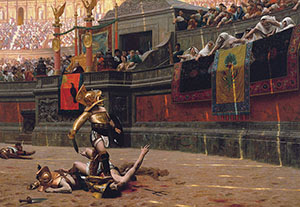
Gladiatorial combat during the Roman Empire (circa 264 B.C. to A.D. 435) resulted in the death of some 3.5 million, while according to Josephus (vi.ix.3), the Jewish Revolt of 68-73 B.C. ended in 1.2 million Jews killed in Jerusalem by the Romans. Muhammad Shah, Sultan of Kulbarga, fought Bukka I, Raya of Vijayanagar in 1366 and massacred 500,000 Hindus.
Gladiatorial Combat
wikimedia.org (Jean-Léon Gérôme) in public domain
Zulu punishments in Africa in the early 19th century included a particularly barbaric form of impalement, called ukujoja, in which the victim was seated atop a sharply pointed stick elevated into the air. The weight of the victim’s body would bear down as the stick burrowed its way upward through body organs until finally reaching the heart and lungs to bring the release of death. Sometimes, a branched stick was used that would split once inserted (Berglund, 1976, p.195, note 89; Bourquin, 1979; cf. “Impalement,” n.d.).
During the 20th century, Stalin’s regime in Russia (1924-53) resulted in 20 to 30 million deaths of his own countrymen. In the People’s Republic of China, Mao Zedong’s regime (1949-1975) resulted in 40 million deaths. The Khmer Rouge in Cambodia (1975-1978) killed some 1.6 million people. Tyrants and dictators have extinguished from the Earth literally billions of human beings over the course of history.
The total number of casualties in World War I, both military and civilian, was about 37 million: 16 million deaths and 21 million wounded. Over 56 million deaths occurred in World War II (counting both military and civilian deaths). Over half a million died in the American Civil War. Some 1.2 million died in the Korean War. Estimates range from one to three million deaths from the Vietnam War.
More recently, tortures employed by terrorist groups include the forcible extraction of all 10 fingernails, all 10 toenails, and all 32 teeth—before executing the victim by such barbaric techniques as slow decapitation via a butcher knife. The 2001 terrorist attack by Muslim terrorists resulted in commandeered aircraft careening into buildings and killing over 2,500 unsuspecting innocent people. Imagine the unimaginable horror of mafia style thugs inserting a dental fixture into the mouth of their victim, forcing his mouth to remain open, while they release a venomous viper into his mouth which slithers down the esophagus and commences to perforate the stomach lining with fangs that inject venom, initiating an excruciating death. [See also “Common Methods of Torture…,” n.d.; “The 15 Most Brutal…,” n.d.]
Consider the unspeakable suffering inflicted on children by depraved adults. Like the UK rock star that admitted to attempting to rape an 11-month-old baby boy and also conspiring to rape a baby girl (Sieczkowski, 2013). Some 45% of rapes reported to the police in South Africa are child rapes, and 50% of South Africa’s children will be abused before the age of 18 (Krever, 2014). Consider the man in Louisiana who raped his eight-year-old stepdaughter, inflicting what the court styled “hurt and horror” on his victim (Miller, 2009). Large numbers of innocent children have been tortured, sexually abused, and discarded to endure a lifetime of unresolved torment and anguish. What’s more, the lives of over 50 million unborn children have been extinguished (in America alone—400 million in China [Morse, 2013]), without ever seeing the light of day, by the grizzly techniques of abortion doctors.
All such atrocities do not even include the host of circumstances that create untold suffering in the lives of millions: betrayal, divorce, depression, alcoholism, drug addiction, financial disaster (such as the loss of one’s job and house), and crime. For youth between the ages of 10 and 24, suicide is the third leading cause of death in the U.S. (“Teen Suicide…,” n.d.).

SEEMINGLY CAUSELESS SUFFERING

And what of the unprovoked and apparently undeserved host of heart-wrenching hardships to which the world of humanity is regularly subjected? Widespread and pervasive illness, sickness, and resulting death occur without any apparent connection to an individual’s own actions. In many cases, we inherit the genetic foibles of our ancestors that make us susceptible to heart disease, cancer, diabetes—and the list goes on and on. The average individual must endure the heart-breaking trauma of the death of loved ones—a spouse, parent, child, or dear friend—who die from unwarranted and undeserved physical ailments. Innocent children are born with debilitating birth defects through no fault of their own.
Think of the people in history who were forced to live in leper colonies—like the cinematic depiction of Judah Ben Hur’s mother and sister—quarantined from society to live in caves and squalor. What about the countries and societies throughout history whose populations have endured mass starvation from famine and drought?
Human error and freak accidents have claimed many lives. Automobile accidents kill and maim thousands. Many innocent people have died from plane crashes due to mechanical difficulties or pilot error. Many lives have been lost on ships at sea (like the Titantic). Accidental shootings, where guns discharge unexpectedly and unintentionally, cause death and suffering. Where’s the sense in the accidental drowning of children? Every day, about 10 people die from unintentional drowning—two of which are children under age 15. The U.S. Consumer Product Safety Commission says 390 children die annually in pool and spa drownings (“New CPSC Data…,” 2012). In fact, drowning ranks fifth among the leading causes of unintentional injury death in the United States (“Unintentional…”).
Need I go on? The world is literally drenched in heartache, misery, and agony. Life is saturated with horrific suffering. Multiplied billions of people have been the recipients of untold distress and misery throughout the millennia. Why? How can this be? Why do bad things happen to good people? Where is God? Does He really exist? How can He stand idly by while the teeming masses of humanity writhe in anguish and affliction? Or for that matter, why would He create a world in the first place—and then introduce humans into an environment where such circumstances prevail? Is He a sadistic monster that created humans so He could satiate a perverted desire to see others squirm in agony? “Come now, and let us reason together” (Isaiah 1:18).

THE BEGINNING POINT

No one has all the answers regarding the matter of suffering. However, that does not mean that we do not have logical, satisfactory explanations that are wholly sufficient to make sense of suffering. In fact, only the Christian worldview and the explanations provided by the Bible can enable a person to fit all the puzzle pieces together to make sense of suffering. Only the Bible provides a cohesive, sensible, satisfying whole.
Unsatisfactory Approaches
If the atheists and evolutionists are correct, the physical realm, with its human inhabitants, has no purpose but, rather, is a monumental “cosmic accident” (Gould, 1989, p. 44). Hence, suffering is meaningless and serves no ultimate purpose. It is simply a chance phenomenon in a nonsensical Universe. As Cornell University professor and atheist, Dr. Will Provine, maintained:
Let me summarize my views on what modern evolutionary biology tells us loud and clear—and these are basically Darwin’s views. There are no gods, no purposes, and no goal-directed forces of any kind. There is no life after death. When I die, I am absolutely certain that I am going to be dead. That’s the end of me. There is no ultimate foundation for ethics, no ultimate meaning in life, and no free will for humans, either (Provine and Johnson, 1994, 16[1], emp. added).
Atheists and skeptics maintain that if an infinite Being existed, He would exercise His perfect compassion and His omnipotence to prevent human suffering (e.g., Lowder, 2004; cf. Jackson, 2001). Even for many people who do not embrace formal atheism, the fact that God seems willing to allow misery and suffering to run rampant in the world, elicits a gamut of reactions—from perplexity and puzzlement to anger and resentment.
If the astrologer, the psychic, and the fatalist are correct, suffering is simply “fate.” “It’s written in the stars.” It has all been pre-programmed into the fabric of the Universe. Therefore, the only way to cope is to gain insight into the future by tapping into the psychic forces and cosmic patterns in hopes of anticipating what lies ahead. (Apparently, just knowing what lies ahead is advantageous, though little can be changed). If the Buddhist, Hindu, and the New Ager are correct, existence is cyclical and suffering is the result of passing repeatedly through multiple lives in an effort to “get it right” (whatever “right” is). Since we have no real recollection of mistakes we’ve made in past lives, the suffering now experienced is meaningless and ineffectual in helping us to correct our future lives. If Islam is correct, pain and suffering are the result of failing to submit to Allah, whose harsh, cruel response is to torment His creatures (see Miller, 2005, pp. 206-209).

The Approach that Satisfies

But there is a sensible alternative to these unsatisfactory approaches—one that soothes the natural longings of the human spirit and interfaces with our deepest yearnings: the Christian worldview. Consider: if the God of the Bible exists, He is the Creator responsible for the material Universe. So we simply must first ask: “Why did He create the Universe, specifically the Earth, and then create humans to inhabit the Earth?”
To set the stage for making sense of suffering, consider the following foundational truths that supply a consistent framework—a stable platform—from which one is able to approach life with certainty and confidence in the face of suffering:
  1. I can know that the God of the Bible exists.
  2. I can know that the Bible is His inerrant, inspired Word (and therefore I can know that it contains sufficient explanations to make sense of suffering).
These two “planks” each possess abundant evidence by which they may be substantiated. A consideration of that evidence is beyond the purview of this article. [NOTE: For the evidence that God exists and the Bible is His inspired Word, visit www.apologeticspress.org for a multitude of books and articles that supply that evidence.] Having established the existence of the God of the Bible and the divine inspiration of the Bible, a third plank follows that prepares the way for pinpointing specific reasons why suffering occurs.
3. The Bible teaches that our life on Earth is temporary and will end at death. When a person dies, his or her body goes into the grave, while the conscious spirit enters the hadean realm to await the final Judgment (see Luke 16:19-31). At some unknown point in the future, God will call a halt to human existence on Earth (1 Corinthians 15:20-58). The Second Coming of Christ will be accompanied by all spirits coming forth from hades to be resurrected in immortal bodies (John 5:28-29; 1 Thessalonians 4:13-18). All will then face God in judgment, receive the pronouncement of eternal sentencing, and then be consigned to heaven or hell for eternity (Matthew 25:31-46; Revelation 20:11-15). That being the case, the doctrine of reincarnation (a person experiencing multiple lives on Earth) is untrue, and every person gets only “one shot” at this life. Life will not be repeated and every person must live life with a vivid recognition that existence must be taken seriously in view of its inevitable end.
Since the Bible is the inspired Word of God (cf. Butt, 2007), it is the only document on the planet that was superintended by God when it was produced. The Bible, therefore, is the only reliable guide for ascertaining the meaning of life and human existence. Only the Bible can make sense of the circumstances that attend life on Earth. And, indeed, it provides the perfect explanations for the occurrence of suffering. Its handling of the subject is logical, sufficient, and definitive.
With these fundamental concepts in mind, one may turn to the biblical text in order to ferret out the basic purpose and central meaning of human existence as it relates to suffering. We begin by asking the logically prior question: What is the purpose of the created order?

THE PURPOSE OF THE UNIVERSE: WHAT LIFE IS ALL ABOUT

When God created the Earth, He intended to provide a realm—a suitable environment—in which human beings could live and prepare for eternity. Hence, the purpose of the created order is to give every person an opportunity to decide where to spend eternity. In creating this “realm of spirit preparation,” God put into play every variable necessary to achieve this purpose. Humans must have access to all the necessary features, constituent elements, and characteristics of an environment that enables them to be truly free to make their own choice with respect to their eternal destiny. Humans must have free willand an environment in which to exercise their volition—their personal decision-making powers.
When God created beings in His own image (Genesis 1:26) as the objects of His infinite love (Psalm 33:5; Numbers 14:18; 1 John 4:7-16), those human beings had to be created with certain attributes that would enable them to decide their own eternal destiny. These essential attributes of humanness include: (1) free moral agency; (2) immortality and ongoing existence beyond the physical realm; (3) culpability for one’s own actions; (4) physical life that is spent in a physical realm as the one and only probationary period; and (5) recognition that a person’s eternal fate is determined by his/her response to God in this life (see Warren, 1972, p. 19).
Observe further, that these essential attributes of a human being are designed to go hand in hand with the essential characteristics of a Spirit-preparing world. In other words, God tailored the Earth to be conducive to the accomplishment of the central purpose of human beings making preparations for eternity. This earthly environment was designed to: (1) supply humans with their basic physical needs; (2) allow free moral agency; (3) allow humans to be challenged; and (4) allow humans to learn the things they most need to learn (see Warren, p. 47), including spiritual development.

THE “VALE OF SOUL-MAKING”

With these variables in mind, we can make sense of the role of suffering in the world. The world was created by God for the central purpose of serving as—what English poet John Keats (1795-1821) designated—“the vale of soul-making”:
Call the world if you please “The vale of Soul-making.” Then you will find out the use of the world…. [H]ow then are Souls to be made?...How, but by the medium of a world like this?... Do you not see how necessary a World of Pains and troubles is to school an Intelligence and make it a soul? A Place where the heart must feel and suffer in a thousand diverse ways! (1895, pp. 326-327, emp. added).
Here is the most fundamental feature of human existence which functions as the context for enacting the prime directive for all of humanity. We humans are on this planet for a singular reason that trumps all other purposes, functions, and intentions of life. We are in the midst of our “probationary period.”

The Wisest Man’s Assessment

While this concept permeates the Bible, Solomon’s treatise, Ecclesiastes, provides a succinct expression of the principle. Solomon was declared to be unsurpassed in wisdom and insight into the meaning of life. Ecclesiastes is somewhat of an autobiography that reflects the details of Solomon’s life reported in the early chapters of 1 Kings. Being king and wielding great power and influence, he was in a position to immerse himself in the vicissitudes of life with all the typical endeavors to which humans have devoted themselves throughout time. Consider briefly his earthly pursuits and attainments.
  1. He devoted himself to great feats of labor, toil, and hard work. He involved himself in monumental construction projects—including a beautiful palace of cedar (that took 13 years to build) and a great religious temple (1 Kings 6-7). He built an extensive irrigation system to accommodate the gardens, orchards, groves, and vineyards that he developed (Ecclesiastes 2:4-6). He also constructed a fleet of ships (1 Kings 9:26).
  2. He sought to acquire knowledge, super intelligence, wisdom and insight, and to educate and enhance his intellect (1:13,16-17; 2:12ff.,21,26; 7:11-12,19,23-25). His intellectual prowess was such that he became an author, poet, composer, and lyricist, generating an unexcelled literary legacy that included authoring thousands of proverbs and over a thousand musical compositions (complete with singers and musical instruments of all kinds—Ecclesiastes 2:8). His vast research and acquired knowledge qualified him to be a botanist, zoologist, ornithologist, entomologist, and ichthyologist (1 Kings 4:29-34). People from all over the world visited him just to hear his unparalleled wisdom and insight (1 Kings 10:24).
  3. He amassed great wealth and possessions. He had countless servants, herds, and flocks. He acquired “silver and gold and the special treasures of kings and of the provinces” (Ecclesiastes 2:8). In fact, he accumulated tons upon tons of gold (1 Kings 9:28; 10:14-15). He regularly received gifts of gold, as well as great quantities of spices and precious stones (1 Kings 10:10,14). The drinking vessels in his palace were gold as well (1 Kings 10:21). His throne was made of ivory, overlaid with pure gold. Two lions stood beside the armrests. Six steps lead up to the throne with 12 lions, one on each side of the six steps (1 Kings 10:18-20). Every three years merchant ships arrived bringing more gold, silver, ivory, and exotic animals (vs. 22). The inspired writer gives this summary of King Solomon’s wealth: he “surpassed all the kings of the earth in riches and wisdom” (vs. 23).
  4. He wielded great military capability. He owned and operated thousands of horses, chariots, and horsemen (1 Kings 4:26-28). He gathered 1,400 chariots and 12,000 horsemen; he stationed these forces in several storage cities that he built to accommodate the chariots and cavalry (1 Kings 9:17-19; 10:26). He raised a significant labor force using the survivors of conquered countries (1 Kings 9:20-21).
  5. He secured significant political power, fame, and honor. He ruled over a considerable geographical area and received tribute and services from vassal kings (Ecclesiastes 8:4; 1 Kings 4:21-25; 5:1; 10:1).
  6. He had unprecedented access to fleshly, sexual pleasure—“the pleasures of men—many concubines” (Ecclesiastes 2:8—NASB; 7:26). It seems surreal that one man would have carnal access to literally hundreds of women, but such was the case with Solomon (1 Kings 11:1ff.; cf. Song of Solomon).
  7. It seems he also gave attention to assessing and resisting the aging process in order to retain youthfulness (Ecclesiastes 11:9-10; 12:1-6). American culture most certainly identifies with this concern with its emphasis on creams, gels, hair coloring, clothing, health clubs, and surgical procedures to prolong at least the illusion of youthfulness. [NOTE: Physical exercise, in moderation, does yield healthful benefits (1 Timothy 4:8).]
  8. He also gave attention to the pursuit of pleasure and physical stimulation (Ecclesiastes 2:1-11). He sought to stimulate his body and gratify his flesh with alcohol. He focused on mirth, laughter, and entertainment. Indeed, he fully indulged his fleshly appetites, declaring: “Whatever my eyes desired I did not keep from them. I did not withhold my heart from any pleasure” (Ecclesiastes 2:10).
In essence, Solomon claimed: “I’ve had it all, I’ve seen it all, I’ve done it all! I have immersed myself in all the pleasures and pursuits that earthly life has to offer.” Yet, he was forced to pronounce all these pursuits as “vanity” and a “chasing after the wind” when they are approached “under the Sun”—by which he meant apart from God. While many human endeavors are noble, pure, and worthwhile in themselves, no human endeavor is of any ultimate value unless undertaken in view of God and His will for human beings. Hence, Solomon brought his matchless treatise on the meaning of human existence to a grand conclusion by announcing the central premise of life—the defining principle that gives life meaning and makes existence justifiable: “Let us hear the conclusion of the whole matter: Fear God and keep His commandments, for this is man’s all. For God will bring every work into judgment, including every secret thing, whether good or evil” (Ecclesiastes 12:13-14). Here, indeed, is man’s raison d’etre—reason for existing. Every single feature of life—money and possessions, fame and power, intelligence/wisdom/knowledge, sex, youthfulness, pleasure, toil/work, advancement, etc.—is meaningless if not approached in view of God and His will. Life was literally designed by the Creator and intended to be centered on rendering obedience to Him. The only way to make sense of life—with its incessant suffering—is to assimilate this fundamental principle of existence into one’s being. Rather than merely living “under the Sun,” we must live life “under the Son.”

Logically, Suffering Makes Perfect Sense

We humans have been provided with the ideal environment in which we may freely accept or reject God’s will for our lives. As Christian philosopher Thomas Warren so eloquently explained, the one essential purpose which God had for creating the world was
the creation of a being (who would have descendants like himself) who would be capable of entering into fellowship with him, who would be capable of becoming a son of God, who (thus) would have to be capable of deciding freely to believe him, to love him with all of his heart, to submit to him in obedience, and whom God could love and eventually glorify (p. 44).
God created the ideal environment in which to achieve this purpose. Hence, He allows human beings to be subjected to unpleasant, tragic events—from nature’s destructive forces like earthquakes, floods, tornados, and hurricanes to sickness, pain, and death. Why? These are the result of specific conditions (to be discussed in Parts II and III of this series of articles) that are necessary to God’s providing humanity with this ideal environment. And they are “common to man” (1 Corinthians 10:13).
You see, when natural disasters occur, ravaging human life, no one can legitimately point the finger at God and pronounce Him blameworthy for having created such a world. Why? Because He had a morally justifiable reason for having done so. Human existence on Earth was not intended to be permanent. Rather, the Creator intended life on Earth to serve as a temporary interval of time for the development of one’s spirit. Life on Earth is a probationary period in which people are given the opportunity to attend to their spiritual condition as it relates to God’s will for living. Suffering due to natural disasters and the like provide people with conclusive evidence that life on Earth is brief and uncertain (see Warren, p. 58; Thompson, 1997). They help us to distinguish the temporary from the permanent. In the face of physical calamities, and the host of other features of the created order that can cause suffering, we humans would do well to contemplate our own fragility and finitude, and be driven to look beyond ourselves, and beyond the here and now, to a higher Power Who can inform us as to the meaning and purpose of life. Life is precarious—tomorrow may be too late.
Suggested Resource
Christians understand that no matter how catastrophic, tragic, or disastrous an event may be, it fits into the overall framework of soul-making—preparation for one’s departure from life into eternity. Likewise, the Christian knows that although the great pain and suffering one may experience may be unpleasant, and may test one’s mettle, nevertheless, such suffering is not intrinsically evil. Nor is it a reflection on the existence of an omnibenevolent God. The only intrinsic evil is violation of God’s will. What is required of all accountable persons is obedience to God’s revealed Word (given in the Bible)—even amidst pain, suffering, sickness, disease, death, and natural disasters.

REFERENCES

Berglund, Axel-Ivar (1976), Zulu Thought Patterns and Symbolism, http://books.google.com/books?id=G8fyWcqa-oEC&printsec=frontcover&dq=Zulu+Thought-patterns+and+Symbolism&hl=en&sa=X&ei=LT4WUtLfLeLy2QWN54CYBg&ved=0CC8Q6AEwAA#v=onepage&q=Zulu%20Thought-patterns%20and%20Symbolism&f=false.
Bourquin, S. (1979), “The Zulu Military Organization and the Challenge of 1879,” Military History Journal, [4]4, http://samilitaryhistory.org/vol044sb.html.
Butt, Kyle (2007), Behold! The Word of God (Montgomery, AL: Apologetics Press).
“Common Methods of Torture and Abuse in the People’s Republic of China” (no date), International Society for Human Rights (ISHR), http://www.ishr.org/countries/peoples-republic-of-china/methods-of-torture-in-the-peoples-republic-of-china/.
“Disasters: A Deadly and Costly Toll Around the World” (1997), FEMA News, http://www.fema.gov/pdf/library/stats.pdf.
“The 15 Most Brutal Methods of Execution of All Time” (no date), Brainz.org, http://brainz.org/15-most-brutal-methods-execution-all-time/.
Gould, Stephen J. (1989), Wonderful Life (New York: W.W. Norton).
“Huang He, or Hwang Ho” (2004), Britannica Student Encyclopedia, http://www.britannica.com/ebi/article?tocId=9274966.
“Impalement” (no date), http://en.wikipedia.org/wiki/Impalement.
Jackson, Roy (2001), “The Problem of Evil,” The Philosopher’s Magazine Online, http://www.philosophers.co.uk/cafe/rel_six.htm.
Josephus, Flavius (1974 reprint), The Wars of the Jews, trans. William Whiston (Grand Rapids, MI: Baker).
Keats, John (1895), The Letters of John Keats, ed. H. Buxton Forman (London: Reeves & Turner).
Krever, Mick (2014), “The End of Innocence: Photojournalist Documents Child Sexual Abuse,” CNN, February 26, http://amanpour.blogs.cnn.com/2014/02/26/the-end-of-innocence-in-south-africa-children-raping-children/.
Lowder, Jeffery (2004), “Logical Arguments From Evil,” Internet Infidels, http://www.infidels.org/library/modern/nontheism/atheism/evil-logical.html.
“Medieval Torture,” Medieval Warfare, http://www.medievalwarfare.info/torture.htm.
Miller, Dave (2005), The Quran Unveiled (Montgomery, AL: Apologetics Press).
Miller, Dave (2009), “The Supreme Court’s Sexual Insanity,” Apologetics Press, https://www.apologeticspress.org/apcontent.aspx?category=7&article=2730.
Morse, Anne (2013), “China: 400 Million Forced Abortions, Sterilizations Under One-Child Policy,” LifeNews.com, June 12, http://www.lifenews.com/2013/06/12/china-400-million-forced-abortions-sterilizations-uder-one-child-policy/.
“New CPSC Data Show Child Drownings in Pools and Spas Still A Leading Cause of Death” (2012), The U.S. Consumer Product Safety Commission, 12-186, May 24, http://www.cpsc.gov/en/Newsroom/News-Releases/2012/New-CPSC-Data-Show-Child-Drownings-In-Pools-and-Spas-Still-A-Leading-Cause-of-Death/.
Provine, W.B. and Phillip E. Johnson (1994), “Darwinism: Science or Naturalistic Philosophy?” Origins Research, 16(1), Fall/Winter, http://www.arn.org/docs/orpages/or161/161main.htm.
Sieczkowski, Cavan (2013), “Ian Watkins, Lostprophets Singer, Pleads Guilty To Attempted Rape Of Baby, Multiple Child Sex Offenses,” The Huffington Post, November 26, http://www.huffingtonpost.com/2013/11/26/ian-watkins-lostprophets-guilty-rape_n_4344037.html.
Taubenberger, Jeffery K. and David M. Morens (2006), “1918 Influenza: the Mother of All Pandemics,” Emerging Infectious Diseases, 12[1], January 2006, http://wwwnc.cdc.gov/eid/article/12/1/pdfs/05-0979.pdf.
“Teen Suicide Statistics” (no date), Statistic Brain, http://www.statisticbrain.com/teen-suicide-statistics/.
Thompson, Bert (1997), “Divine Benevolence, Human Suffering, and Intrinsic Value,” http://apologeticspress.org/apPubPage.aspx?pub=1&issue=468&article=209.
“Unintentional Drowning: Get the Facts,” Centers for Disease Control and Prevention, http://www.cdc.gov/homeandrecreationalsafety/water-safety/waterinjuries-factsheet.html.
Vergano, Dan (2014), “1918 Flu Pandemic That Killed 50 Million Originated in China, Historians Say,” National Geographic Daily News, January 23, http://news.nationalgeographic.com/news/2014/01/140123-spanish-flu-1918-china-origins-pandemic-science-health/.
Warren, Thomas (1972), Have Atheists Proved There Is No God? (Jonesboro, AR: National Christian Press).